and look away . . .

I’ve just recently learned that my old friend, Jack Le Sueur, retired from the North Carolina Arts Council last December after thirty-five years’ service. Thinking about Jack brings back a flood of memories of a life I no longer have—of friends and places, sights and sounds: shaking hands with Jimmy Carter in the town park in Southern Pines, a copy of T. S. Eliot’s poems I bought in the Intimate Bookshop on Franklin Street in Chapel Hill when there was still such a place, the smell of woodsmoke at the Malcolm Blue Farm in Aberdeen, and the fireplace poker Jerry Darnell made me at his forge there one day. So many details, flakes of being floating on a river that never stops running.

Many of those memories include Jack. We met in 1974, some time in the fall, I think—though it’s been too many years to be sure. I got a call one day from a young man who had just taken a job with the arts council in Raleigh, and he wanted to come and see me. In a few days he showed up at the Campbell House in Southern Pines where I was housed as Executive Director of The Sandhills Arts Council (now the Arts Council of Moore County). We drove around the county all day together, getting to know one another and looking the place over. I had been on the job only about a year at that time. But I knew enough to take Jack to Jugtown, then operating as a nonprofit under the tutelage of the late Nancy Sweezy. I think I remember that we watched as interns unloaded one of the pottery’s big groundhog kilns.

And I’m sure I must have remembered to introduce Jack to board members and any community leaders I could find. I must have taken him to see Sam Ragan in his office at The Pilot, where he hid out behind a three-foot-tall pile of manuscripts that took up the front of his desk and banged away on the old Underwood he used to do his writing. But my memory of that day with Jack is mostly a recollection of country roads—Moore County is a beautiful place—and of pleasant conversation with a soft-spoken young man who was ten years younger than I but already an ex navy officer and a graduate of Duke, where I had studied for a PhD I never managed to get.

In his years at the North Carolina Arts Council Jack had many jobs. In those early days his job title was Community Coordinator. Jack, and later Fred Schultz, traveled the state as liaisons with local arts groups of all sorts. It was a natural step for Jack to become the administrator of the Arts Council’s signature Grassroots Arts Program, a program that’s been much copied around the country and a source of public funds for arts efforts large and small that continues to this day. But to me Jack was the North Carolina Arts Council, its face and its true soul, the embodiment of bureaucracy with a heart, something I guess I still believe is possible. Jack had a wonderful way of striking a balance between being my friend and advocate, which he mostly was, and sometimes being my boss. There was no pretense in him, no self-importance. He was always just Jack.

Hardly a month went by that we didn’t talk on the phone, sometimes just because he’d call to check in and see how I was. We’d meet at least four or five times a year at meetings and workshops, my favorite of which was a meeting of us professionals at the Quail Roost Conference Center, usually around Christmas time every year. We’d sit around a big seminar table and hear reports and instruction from peers during the day, and we’d party in the evenings. I remember one good poker game when I think I won ten dollars. I’m sure there were other communities of culture around the country like the one I was part of in North Carolina in the 1970s, but I was privileged to be part of that one. Thinking of Jack still takes me back to a time before the culture wars ruined so much of life for us, albeit I’ve not seen him these last twelve years. It was like Kristofferson’s great song; we were advocates for everything good we knew.

And so I’m moved to learn of Jack’s retirement and wish him godspeed in whatever future he travels. Jack is a fine musician. We used to spell one another at meetings singing and leading singing. He and his wife, Pattie, began performing together before they got married and have continued to do so over the years. They have a lovely CD that includes a wedding song, “Two Paths.” I hope Jack’s future holds lots of opportunities to perform and that I get to hear him and Pattie again before I go somewhere else. Here they are in a little video medley from a few years back that I found posted on the net. Jack’s “Administrator Blues” reminds me of a meeting in Denver when a couple hundred of us listened to Jack sing one evening and there were lots of lighters in the air at the close. I also especially like the Kate Campbell song that’s last in the video, and Pattie’s take on it, speaking of things the culture wars have ruined for us.

blowin’ in the wind

The death of Jody Powell at the young age of 65—here’s a Times memorial piece I like—ensures that he will remain a whiz kid, at least in my memory. And it causes me to think again of September, 1973, when I was a very young community arts council executive running his first local festival in the Southern Pines, NC town park.

A group of politicos, stumping for Bill Hefner, running then for his first term in the U. S. Congress, came to see us. It was a fine, fall day. The park was full of folks. The Bluegrass Tar Heels had already warmed up the afternoon. Hefner’s gospel group fit right in; they had somehow missed their audience and found ours. During the singing I surveyed the park and waxed expansive about it all. At one point I felt a tap on my shoulder and turned to find a handshake and a big grin on the face of a sandy-haired fellow who introduced himself saying, “Hi! I’m Jimmy Carter. I’m the Governor of Georgia.” I don’t remember what we talked about, but I’ve loved him ever since, admired him and voted for him twice for president.

He’s in the news today, pointing out the obvious—that much of the most vocal opposition to President Obama is racist. And he’s been slandered all over the place. Perhaps the worst attack is in today’s National Review Online. Carter, these sagacious editors say, is guilty of “playing the race card.” His “accusations” are “both banal and cynical” and “right on cue.” Of course, Mr. Carter made no accusations; he responded to questions, stating a view that’s held by many supporters of the present administration. But in an incendiary political atmosphere being stoked by the racist cant of Glenn Beck, Lou Dobbs, and Rush Limbaugh, any mention of race counts as an explosive device. This, I suspect, is why Ben Smith termed Carter’s comments bad politics.

On another note, the Associated Press is reporting tonight that Mary Travers is dead, having lost the fight she has waged with leukemia for the past several years. My beloved and I heard one of the last Peter, Paul and Mary concerts here, at the Fox Theater, a few years back, a concert we attended with a politically mixed group of friends who loved that music.

Obits are already associating Travers with the liberal causes she and her partners, Paul Stookey and Peter Yarrow, espoused; but Peter, Paul and Mary belong to American history as Pete Seeger, Woody Guthrie, indeed the whole folk music movement do. “Their sound is gone out into all lands,” as the scripture says.

Here’s one of my favorite Peter, Paul and Mary Songs, apolitical perhaps, written by Gordon Lightfoot.

“alive as you and me”

Thinking about Joan Baez, especially about her impassioned rendition of the old labor ballad of Joe Hill (and perhaps thinking of professor Gates as well) set me to thinking about other musicians whose singing has moved me and others, and who also have been passionate about politics. For me, “Joe Hill” will always be territory owned by Paul Robeson, that great and tragic American whose name was always mentioned with respect tinged with dismay and sadness in my childhood home, at least after the time I became aware of politics during World War II.

Whatever else he was, and he was many things, Paul Robeson was hugely talented, a great singer, perhaps the greatest American-born voice of his century. Still, as his biographer, Martin Duberman, points out in The New York Review of Books:

It is the familiar “liberal” anti-Communist judgment on Robeson [that] he was a Stalinist and a philanderer, personally agreeable, not very insightful and not very talented (though very, very lucky).

If I shared that view I wouldn’t be writing this, for surely Robeson’s eulogy of Stalin does not qualify him as a Stalinist in our present-day sense of that term. Duberman calls him “a great-hearted and sophisticated black radical.” In the politically complex time between the two world wars he found room in the world for his art and his radical, socialist politics. For the politically simplistic 1950s, he became a pariah, so much so that his career and his undoubted accomplishments were erased from the history of his time. Now, the erasure remains, a curious absence. Though we are able to speak of him again, we speak of him in the same breath with J. Edgar Hoover and Joseph McCarthy.

We cannot revive old factions
We cannot restore old policies
Or follow an antique drum.
These men, and those who opposed them
And those whom they opposed
Accept the constitution of silence
And are folded in a single party.

Paul Robeson died in obscurity in 1976, but the Robeson voice can still be heard, on a number of recordings of surprising quality. Here’s Robeson’s recording of “Joe Hill.” It’s my first experiment making a video, and I’m rather proud of it. You can crank up the sound, if you like.

presences among us

To see the earth as it truly is, small and blue and beautiful in that eternal silence where it floats, is to see ourselves as riders on the earth together, brothers on that bright loveliness in the eternal cold — brothers who know now they are truly brothers.

–Archibald MacLeish

MacLeish’s evocation of liberal hope, as moon missions of the 1960s began to exert their influence on popular culture, was first published in The New York Times on December 25, 1968 and is now iconic. I don’t think its hope is tarnished by the fact that realization remains “halfway to the moon” or further out of reach in the post 9/11 world.

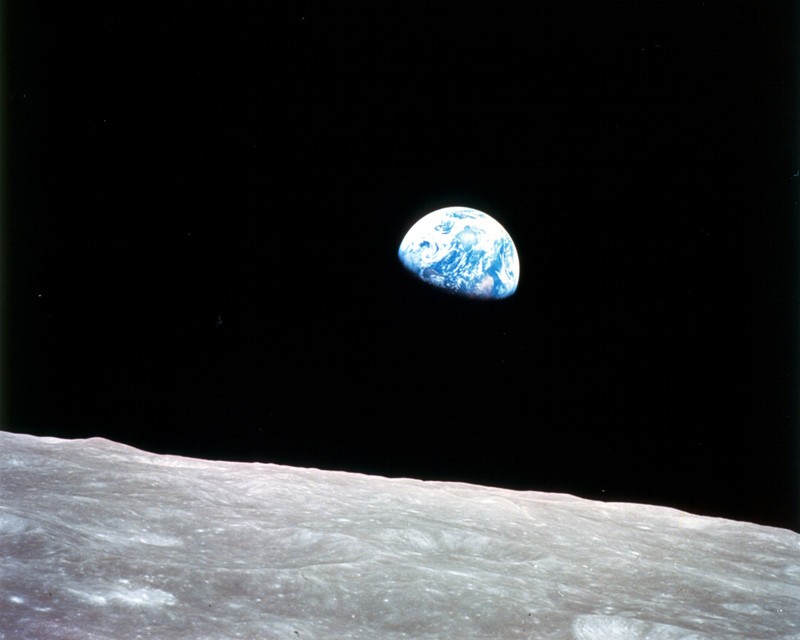
Thinking about today’s anniversary of the Apollo 11 Moon landing sent me in search of memorabilia. For years I used the famous whole earth image as a screen saver. But here are a couple of images I like better now, downloaded from the NASA website. The first images of earth from space (including these two) were created in 1968, before the first moon landing, by the astronauts of Apollo 8, the first manned space mission to orbit the moon. I like the first I show for its composition and for what looks like a tiny, far-off planet just beneath the blue earth as it hangs in the black sky.

The second image is one of many to have been given the somewhat problematic title, Earthrise. But I think it must have been a photograph like this one that inspired MacLeish’s famous New York Times poem, published to coincide with the landing of Apollo 11 but written earlier.

VOYAGE TO THE MOON
Archibald MacLeish
(1892-1982)

Presence among us,

wanderer in the skies,
dazzle of silver in our leaves and on our
waters silver,
O silver evasion in our farthest thought–
“the visiting moon” . . . “the glimpses of the moon” . . .
and we have touched you!

From the first of time,
before the first of time, before the
first men tasted time, we thought of you.
You were a wonder to us, unattainable,
a longing past the reach of longing,
a light beyond our light, our lives–perhaps
a meaning to us.

Now our hands have touched you in your depth of night.

Three days and three nights we journeyed,
steered by farthest stars, climbed outward,
crossed the invisible tide-rip where the floating dust
falls one way or the other in the void between,
followed that other dawn, encountered
cold, faced death–unfathomable emptiness . . .
Then, the fourth day evening, we descended,
made fast, set foot at dawn upon your beaches,
sifted between our fingers your cold sand,

We stand here in the dusk, the cold, the silence . . .
and here, as at the first of time, we lift our heads.
Over us, more beautiful than the moon, a
moon, a wonder to us, unattainable,
a longing past the reach of longing,
a light beyond our light, our lives–perhaps
a meaning to us . . .

O, a meaning!

Over us on these silent beaches the bright earth,
presence among us.

And speaking of presences among us, My beloved and I went to hear Joan Baez sing last evening at The Pageant on the Delmar loop. For me, she was as magical as ever. Though her voice lacks some of its former power, particularly the strong upper register, it’s sweeter now, and the fast vibrato that used to bother me sometimes has smoothed out. She has a terrific band, but she did about a third of the show by herself, including her last encore, when she sang “Diamonds and Rust.” Lots of memorable lines and licks in the show: “When first I came to Louisville,” “Come back Woodie Guthrie,” “I believe in God, and God ain’t us.” Here’s the chorus of an Elvis Costello song I liked a lot.

We’ll rise above the scarlet tide
That trickles down through the mountain
And separates the widow from the bride . . .

For the truly nostalgic she sang “Silver Dagger,” “Forever Young,” “Old Dixie Down,” “Farewell, Angelina,” and “Don’t Think Twice, It’s All Right.” For the community organizers in the audience she delivered a rousing rendition of “Joe Hill,” as well as John Lennon’s “Imagine,” and Steve Earle’s “Jerusalem.” She threw in a spot-on impression of Dylan for the last verse of “Don’t think Twice” that brought the audience to its feet. But my favorite thing was an unaccompanied performance of “Angel Band” (which the Riverfront Times reviewer apparently didn’t know). With the other musicians singing along, that lovely old gospel song sounded for all the world like it might in a country church somewhere in eastern North Carolina . . . “O bear me away on your snow white wings to my immortal home.”