
when the forty days were o’er . . .

Sunday is Passion Sunday, another Holy Week begun. And I am more than usually skeptical about the certainties of Easter. The week’s collection of news stories complicates my skepticism for me — why do I keep at it, I ask myself, when the core beliefs no longer matter to me and the faith has come to seem a system of pale negations, as it did for Emerson. Part of the answer is simply that I do what I do. What I believe has come to be embedded in the ordinary round of my life, my religion more and more a set of qualifications I fully expect to become meaningless upon my death, closer to me now than it once was. The week’s news doesn’t help me much, but here are some stories that, for one reason or another, stand out.

This week the House of Bishops of my church formally consented to the deposition of John-David Schofield and William Cox. The background of both depositions is the complex of disputes about sex and gender in the present-day Episcopal Church. The House of Bishops also this week reacted to news that an invitation to the Lambeth Conference of Anglican Bishops is not possible for Bishop Gene Robinson. More sexual politics. In the Catholic Archdiocese of St. Louis two women who were ordained Roman Catholic Womenpriests were excommunicated, and Catholic Archbishop Raymond Burke continued his efforts to remove Fr. Marek Bozek from his position as Pastor at St. Stanislaus Catholic Church.

I’m in the curious position of supporting the deposition of the two former bishops of the Episcopal Church and deploring the attempts of Archbishop Burke to discipline various members of his flock. If I had to play gotcha with some media type, I’d be caught in a drop-dead contradiction; but my two–let’s call them inclinations rather than positions–are embedded in two different histories that only accidentally come together in my experience. And apropos of one of those histories, I am not awaiting the new Pope’s promised challenge to Catholic educators, expected during his trip to the U. S. next month, with any pleasure. Benedict doesn’t have a good record with respect to academic freedom, and recent events adjacent to the SLU campus, here in St. Louis, don’t give me great comfort either.

Barack Obama’s former pastor, Jeremiah Wright, was in the news a couple of times this week. First, this video, which Ben Smith calls “deeply racially confrontational,” traveled around the .net, apparently first posted by Fox News. Obama says he “vehemently condemn[s]” the statements in the video in an essay at Huffington Post. They certainly won’t help him get elected or help the United Church of Christ defend itself against the IRS. Funny, the Ferraro comments barely fade from the news and here’s this. It isn’t new, by the way, as Obama points out.

Then there’s this sermon, which I also have from Ben Smith, the sermon from which Obama borrowed the title for his second book, The Audacity of Hope. Smith seems to think the sermon shows a different side of Wright than the one on display in the video, saying the sermon is “much more about private despair and hope than about public life.”

I think The Audacity to Hope has a public dimension, and I also think the sermon fragment I see in the video could be a legitimate prophetic sermon about racism. It isn’t the fact that it is confrontational that is disturbing–it’s the personal attack and the too simple black vs. white argument about Jesus. Still, I share the hope that God knows what it is like to be black in a world run by rich white people, and I share the view that white privilege needs to confront itself. This isn’t a view promulgated just by the United Church of Christ. My own church devotes a special initiative to Dismantling Racism. Many of the materials we use were developed by Mennonites.

So, on Sunday I’ll help read the passion gospel and mark again how the prophetic message has been blunted in Jesus’ sermons and life story, starting with the gospel writers, been rendered “more about private despair and hope than about public life” — for a world that has never liked to be confronted with it’s hypocrisy and injustice. Afterwards I’ll collect my palm and go home, where I’ll put it away on top of the bookshelf.

fouling in the endgame

The score is 86 to 79, and there is a minute and a half to play in a game between two big-time NCAA basketball teams. The game is a regular season game, no more of a must-win for either team than any other, but the losers have already started to foul the winners. Each time the winning team gets the ball, the member of the losing team with the lowest number of infractions scored against him fouls the member of the winning team with the poorest record at the foul line. The fouled player goes to the line, makes one or two points, or none; and the losing team gets the ball back and a chance to score a two- or three-point field goal. The losing team scores or not, gives up the ball, and fouls again. This scenario will repeat itself until the final buzzer.

Most basketball games end this way these days. It’s normal, what we expect, not remarkable. If a losing team should opt out of the procedure and play out a game without fouling, fans and sportswriters would call them losers, accuse them of lacking in competitive spirit, or worse yet, lacking a proper work ethic. Their coach would be vilified for failing to teach them proper values, and perhaps be fired. The fact that this style of play is unsportsmanlike, involves intentional rule breaking, and is something that a society that values fairness and the rule of law ought to reject, has never seemed to occur to anybody since the practice began forty or fifty years ago. By now, as I say, it’s normal, what we expect. A species of flagrant unsportsmanlike conduct has become the right thing to do.

If I ask myself why this should be so, part of my answer has to recognize that we live in a society in which winning trumps everything else. It’s so important to be a winner, to be associated with winners and winning (and even more important, not to be a loser), that when some curmudgeon like me questions some injustice that is broadly perceived to be an enabler of winning, I (or whatever person does this) will automatically be accused of 1) not understanding how things are and what’s really important, 2) being a wimp or a wuss (that is, a loser), or at a certain level at which this discourse is sometimes pursued, 3) being un-American or unpatriotic.

We live in a time in which the Presidency of the United States (at certain times in the last century called imperial), has largely become a criminal enterprise, pursuing an illegal program of domestic spying, detaining foreigners without due process of law, engaging in criminal torture, and pursuing a foreign war that has no strategic or other value to this country outside the interests of a venal military establishment and the presidency’s own need for legitimacy and a second term in office. The president who led us into this situation is now vastly unpopular. It ought to be possible to deconstruct the moral pretensions of his administration and put right at least some of its most egregious wrongs.

But apparently not. George Bush is unpopular because he didn’t win the war in Iraq, not because his depredations have offended the moral sensibilities of a great number of Americans. John McCain, who aspires to be Bush’s Republican successor, tells us that we can still win the Iraq war if we just hire him as the new coach; and he has now backed away from any criticism of the war or opposition to torture, echoing the president’s claim that waterboarding is a crucial tool in the war on terror, so as to appear tough and patriotic — to look like a winner, one supposes. Even Barack Obama, perhaps the war’s most serious critic among remaining presidential candidates, has criticized the war on pragmatic, not on moral, grounds.

Looking like a winner can be as important as winning in today’s high-stakes political arena. Ron Elving reviews the results of the Texas Primary/Caucus at npr.org and argues that the Clinton campaign had anticipated a split decision before it occurred.

That’s why efforts had been made to discredit the caucuses in advance. Her campaign complained that the caucuses were too small to be representative and too random in administration to be fair.

On caucus night, her campaign held a stormy conference call with reporters to say Obama forces were attempting to hijack the proceedings at specific sites. Similar complaints had been lodged against caucuses in other states in January and February, as the Obama campaign racked up consistent wins in delegate counts.

The Clinton campaign have consistently followed an endgame strategy of fouling their opponent, gaining whatever short term advantage that strategy can produce, in order to look as much like winners as possible. Clinton even gave a victory speech after the Iowa caucuses, and has continued to follow that strategy as she has lost contest after contest. With respect to Texas,

. . . most of the country will go on thinking that Senator Clinton collected a bonanza in Texas . . . . So even if she didn’t, and even if she did not quite meet her own goal . . . , she got her momentum back . . . .

That is: she started to look like a winner again.

the real audacity of hope

Tim Burke has a really good piece up this morning about what’s at stake in the presidential election. Here’s a sample:

Everything that works about institutional life rests on the habitus of professionals, bureaucrats, experts, on whether they are stewards or parasites, whether they recognize the fragile possibility of a better world or are just looting the till, whether they are humble in the face of wider and more distributed experience and knowledge or whether they are contemptuous of anything besides their own immediate power. We all know it: this is Arendt’s banality of evil. We do not need to fear the person at the top, but instead the mass force of institutional action.

Tim seems to argue, as I believe, that the last eight years have uniquely politicized governance. I would only add that part of the reason the last eight years have undermined the ability of the liberal state to govern disinterestedly in this country is that the reins of the state have been in the hands of ideologues who believe neither in disinterestedness nor in governance. One commentator on Tim’s blog argues that the administration previous to the last eight years was similar, in that “The Clintons specialized in . . . the politicization of government activity” as well. Only too true, but the Clinton administration still retained some respect for the liberal state.

Tim references a 60 Minutes piece, broadcast this past Sunday “on the case of former Alabama governor Don Siegelman, who very much appears to have been the target of a Karl Rove operation,” and a Harper’s essay, by Scott Horton, summarizing and commenting on it. I missed 60 Minutes on Sunday, and was glad to see the Horton essay. However, I watched a piece on Missouri public television that I think everybody who believes that the quest for racial equality is completed in this country ought to watch. It’s called “Banished,” part of the Independent Lens series on PBS. Here’s a trailer.

Read Tim’s piece, entitled “We’re Americans First,” here.

sleaze, if you please

Here’s the United States flag pin that Barack Obama declined to wear after he became a presidential candidate (or one very similar to it). By doing this, he has earned the disapprobation of superpatriots and other wise folk such as the smiling yet serious William Kristol. How in the world this is a news story is mystery to me, and how in the world it deserves the column inches The New York Times gave it yesterday I can only refer to the sagacity of those editors who chose to run the really serious story about John McCain and Vicki Iseman.
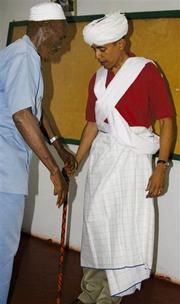
And here’s the AP photo of B. Hussein Obama, Islamofascist candidate for the democratic nomination, dressed up in his native costume, as circulated via the Drudge Report. I guess this level of sleaze does credit to a country of fans that tuned in nightly for the latest Clinton/Lewinsky update and are still perhaps titillated by the machinations of Paula Jones, and Gennifer Flowers (added Tuesday morning).

Drudge has claimed that the Clinton campaign circulated the photo, hoping (one supposes) to score some points with the redneck contingent in Texas and Ohio. The Clinton campaign has denied any complicity. Plouffe has posted a stern rant. Obama has stayed cool (more or less).

What the hell — it’s Monday!

Of course, we’ve always had sleaze going back to the early days of the republic. Think about the careers of Andrew Jackson and Abraham Lincoln. Sleaze is the underside of democracy. To hate it is perhaps to embrace an elitism that makes against the very empathy my guy is trying his best to stir up amongst us. So I won’t hate it. I won’t . . .