
It’s an old Yiddish saying, I’m told. Here’s another favorite fiddle tune, Flatbush Waltz — written by Andy Statman. The mandolin soloist is Statman, himself. The fiddle player is Itzhak Perlman. I liked this tune so much when I first discovered it that I wrote a poem about it. My poem is here. If you’re interested in some background, you might want to watch Perlman’s EMI video entitled In the Fiddler’s House. Everyone knows Itzhak Perlman, I think.
Author Archives: Julian O. Long
and now for something completely different
I’ve been playing hookey — just didn’t feel like writing much. Now that I want to get started again I thought I’d post some more music. This may be my favorite fiddle tune. I hear it slow and sentimental, unlike the famous western swing treatments by Bob Wills and the Texas Playboys.
Bob Wills didn’t write Maiden’s Prayer, only some sentimental words for it. Frankie McWhorter quotes Wills in Cowboy Fiddler in Bob Wills’ Band telling the story of how Wills locked himself up with a Mexican fiddle player in Roy, New Mexico, where he was working as a barber.
Bob said, “He played ‘The Spanish Two-Step’ and I locked the door where he couldn’t get out and nobody else could get in, and I made him stay there until he taught me that and ‘Maiden’s Prayer.’ Finally he nodded. I didn’t know whether he needed to go to the bathroom or if I was doing it right, but I let him out.” That Mexican taught him those two tunes.
Here’s a lovely performance featuring Aly Bain and Jay Ungar. Ungar is more famous as the composer of “Ashokan Farewell,” which was used as the theme song of Ken Burns’ Civil War series.
YouTube programs another fine performance (though the photography is less than stellar), featuring Al Joseph with Jerry Vernon and Acie Cargill on guitars. I love it, and I don’t know what’s more remarkable, the fact that it’s “live at McDonald’s” or the shots of the geezers dancing.
rope-a-dope
Or, maybe I’m wrong. Noam Scheiber thinks so, or at least has a different reading of events. Writing for “The Plank” at The New Republic, Scheiber contends it’s all a rope-a-dope and that Obama is in complete control of the discourse and the politics of the stimulus. Here are a couple of salient pragraphs:
Here’s what I’d guess is likely to happen over the next few days: The conference committee tasked with ironing out differences between the House and Senate stimulus bills will undo most of the roughly $65 billion in cuts to state aid, education, and health care spending the Senate centrists negotiated. To pay for it, they’ll junk the $70-billion in Alternative Minimum Tax relief the Senate showered on the upper-middle class.
Republicans will protest that Obama and Congressional Democrats have trampled on the Senate compromise and unilaterally re-imposed their liberal priorities. They’ll sprinkle in a collection of shopworn clichés, like “behind closed doors,” and “dead of night.” But, in the end, it won’t matter. The media, having already proclaimed Obama the Beltway’s only bona fide bipartisan, is hardly going to rewrite the narrative at this late stage. And no senator who voted for the bill in the first time around is going to want to explain why he or she suddenly became “anti-job.”
According to this narrative, Republicans tried to hijack the process of developing the stimulus and Obama stole it back. As Scheiber concludes, “By yesterday evening, you could almost see it dawn on Senate minority leader Mitch McConnell that he’d been played.” If this is so, then John McCain’s appearance on Face the Nation last Sunday should be read as damage control, not gloating.
—I hope so.
senate passes stimulus
The Washington Post is reporting that the Senate has just passed the economic stimulus bill as revised by moderate Republicans last week. I suppose one has to be grateful that some action is coming from Congress to the President’s desk, but this isn’t the action I would like to see. It can be argued that the new President made a mistake in watering down the stimulus package in the first place, that he had enough public support going in to overcome the threat of a Republican filibuster in the Senate. Paul Krugman has argued as much in a recent op-ed essay, and I agree. Here’s how Krugman describes the administration’s alleged mistake:
. . . [M]any people expected Mr. Obama to come out with a really strong stimulus plan, reflecting both the economy’s dire straits and his own electoral mandate.
Instead, however, he offered a plan that was clearly both too small and too heavily reliant on tax cuts. Why? Because he wanted the plan to have broad bipartisan support, and believed that it would. Not long ago administration strategists were talking about getting 80 or more votes in the Senate.
But that was never going to happen, and here’s how it played out. Rush Limbaugh announced that he hoped President Obama would fail, even as the president was earnestly seeking Republican input and support for the stimulus package (big media event). The President seemed rattled, appeared to strike back. Then, all House Republicans voted against the package and blamed Nancy Pelosi. Subsequently Lindsay Graham and others appeared on the Senate floor and in the media to attack the stimulus package in advance of the Senate’s votes on the bill. “[T]he stimulus legislation was not handled in ‘a true bipartisan fashion,'” Graham bloviated in the best Limbaugh style. And what’s the evidence that countered Obama’s overtures to Republicans over the past weeks? As John McCain explained last Sunday on Face the Nation, All House Republicans voted against the stimulus and “all but three Republicans stayed together” in the Senate. Clearly there had been a Republican decision to oppose the bill and blame the Democrats for their opposition.
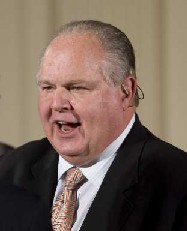
I’m grateful to the Los Angeles Times for this photo of the arch-bloviator, It has appeared in a number of places; the Washington Post references it to J. Scott Applewhite of the Associated Press. And I’m grateful to Al Franken for explaining where Rush Limbaugh gets his facts and opinions. Franken has also called Limbaugh a disinfotainer, using a term I first heard from Howard Rheingold. Disinfotainment is more than mere demagoguery, is marked by deeper strains of deceit and cynicism. The drama makes for good TV, satisfies current standards of newsworthiness. We get bloviation and counter bloviation — balanced reporting requires that somebody like Claire McCaskill balance Graham and somebody like Rachel Maddow balance Limbaugh (though I love Rachel Maddow a lot, and my vote for McCaskill is one of the more satisfying votes I have cast in my life). But in the long run we all suffer from the charade, and the public interest isn’t served when the appearance of fairness gives bad arguments and bad faith equal representation with good. It may be that President Obama is making some rookie mistakes as he did during the campaign, when he generally overcame them. I hope he can do some overcoming now and do it fast. The stakes are high, as he often reminds us himself.
And it could even be the case that this young President believed John McCain and Lindsay Graham when they promised bipartisanship three months ago just after the election and issued a joint statement with him promising to “change the bad habits of Washington.” But McCain and Graham knew they could count on Nancy Pelosi and Harry Reid to give them plenty of opportunities to cry foul, and this time the President gave them one too, in last week’s apeech to the House Democrats at Williamsburg. Here’s Graham crying crocodile tears on the Senate floor afterwards:
What we’ve done is we’ve lost a young president’s promise to change things. . . . [W]e got a chance to start over. We’re in the first month of the administration, and I have never been more concerned about lost opportunity than I am tonight.
One suspects the good Senator’s concern is entirely for the election of 2010, when the Democrats stand to lose congressional seats if history repeats itself. The political calculation is that Republicans potentially have much to gain from voting against the stimulus, and even more if they can weaken it still further. No one expects the economy to improve quickly. Republicans may be expecting to benefit if the stimulus appears not to be working as political campaigning heats up.