“Iowa . . . that’s so yesterday!”

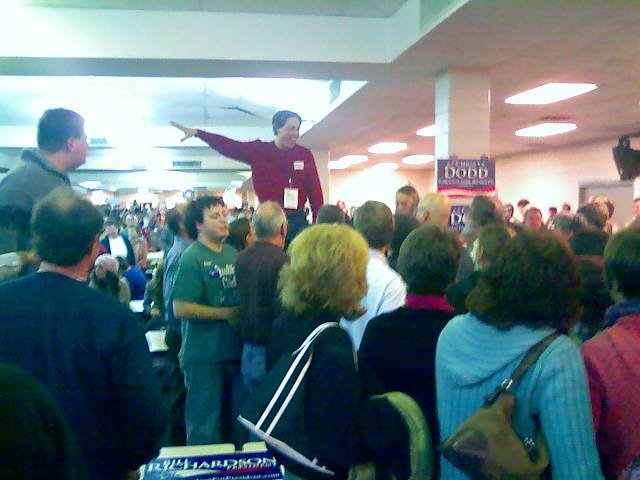
an NPR reporter observed tongue in cheek as we made our way home from Iowa City where we had attended a caucus as observers. With the campaign already moved to New Hampshire, all the analysis going on as we drove back to St. Louis on Friday seemed more retrospective than it actually was. Obama’s win pleased me from the moment I began to suspect it was coming, as we entered the Iowa City High School cafeteria at 6:00 p.m. for a 7 p.m. caucus and found that the Obama space was entirely full already when spaces allotted for the other candidates, including very large spaces blocked off for Clinton and Edwards, were mostly empty. Official voting attendance at our caucus was 719, with 50 or so observers in the room. You can get an idea how crowded it was from the picture on your left. That’s the precinct chair standing on a table trying to direct traffic during the realignment phase.

This morning I was still pleased with Obama’s win, because I’m a lifelong Democrat who thinks it’s extremely important to replace the bankrupt and terminally cynical administration in present day Washington, because I like everything I know about this young professor/senator, and because I responded to Obama’s victory speech much as the editorial writer for the Iowa City Press-Citizen did yesterday morning: “Got hope? Iowa does. More than enough to share.”

First-round voting at our caucus broke down as follows: 333 Obama, 130 Edwards, 105 Clinton, 53 Biden, 43 Richardson, 26 Kucinich, 19 Dodd. The threshold of viability in the first round of voting in the Iowa Democratic caucuses is 15%, which meant 108 votes at our caucus. Clinton was not viable in the first round but picked up 15 votes in the realignment phase to finish with 120. Voters for Richardson, Biden, Dodd, and Kucinich were unable to get together as a group, and some left without casting a second vote. Others realigned with the three winning candidates. Obama and Edwards finished with 384 and 169 votes respectively. I know personally that one final voter for Clinton was persuaded to switch from Obama by the argument that Obama wouldn’t miss one vote, but Clinton’s situation was desperate.

All in all, it was enough to raise my aging consciousness, punch my political junkie card, and make me proud of my country. I’m still proud, though the swift boating has already started. This afternoon I had a phone call from someone, purporting to represent the DNC, who asked me who I’m supporting for president. When I said Obama this person responded, “Aren’t you afraid he doesn’t have enough experience to be president?” I expect my caller represented some Clinton surrogate rather than the DNC. “What’s the national committee doing campaigning against a Democrat?” I asked as the phone went dead.

I know some Americans would like to have some better system of determining party nominees than the patchwork system we have. I like the present system because it leaves room for small places like Iowa and New Hampshire to contribute their brand of town meeting politics to the mix. I’ll be watching tonight’s TV debate with great interest, though, now that I have some skin in the game.

Changing Attitude, Nigeria

are reporting that the Same Sex Marriage . . . Act 2006 seems stalled in the Nigerian House of Representatives. This, apparently, does not mean that the bill will not pass; but there seems to be hope that it will die after elections currently scheduled to take place on April 21. I think the following paragraph from the Changing Attitude press release is particularly interesting.

What we are hearing from CAN members in Anglican congregations in Nigeria is that the church leaders have been feeling big pressure on them and some are very angry because they expected the bill to be voted on prior to the end of this session. There are also rumours that money has exchanged hands, American money, and yet it has not proved easy for the Anglican Church leaders to push the bill through the House of Representatives. Corruption remains widespread at every level of Nigerian society. (emphasis added)

And I wonder who in the United States might be interested in pushing this bill through the Nigerian House.

At the same time, Ruth Gledhill reports she has spoken with a friend of the Archbishop of Nigeria who argues that Archbishop Akinola has been demonized in the western press, “There is a demonisation of Peter Akinola taking place which really is not fair, and sits very ill at ease with the remembrances on the abolition of slavery,” said Gledhill’s informant referring to the current bicentenary celebration going on in Britain; “It seems that Africans are to be welcomed and apologised to, unless we happen to disagree with them.”

Gledhill is aware, as well, that one aspect of this story which has had scant attention in the west is the Same Sex Marriage Act’s possible relation to fears within Nigeria that coming elections might result in an expansion of the sway of Islamic Law. Three somewhat different takes on prospects for the coming elections in Nigeria may be found here, here, and here.   

war and peace again

Two more posts from Henry. The first is here, and the second is here.

Henry, I agree that evoking Gandhi and Martin Luther King in the present circumstance is not helpful, and I’m remembering what Dale has said down the page about extremes. I also agree that the threat of Jihad is serious, though I don’t subscribe to the notion that Islamic militancy is unified or monolithic. It seems pretty disorganized to me, and I suspect that most of its adherents have no notion of a caliphate.

As to what constitutes a serious position about Iraq, David Brooks has an opinion piece in today’s New York Times that sets out pretty clearly at least part of what I think. I can’t post a link because it’s in a paid part of the NYT site, but here’s the most of his conclusion. Brooks argues that there are at present two serious positions about Iraq:

One serious position is heard on the left: that there’s nothing more we can effectively do in Iraq. We’ve spent four years there and have not been able to quell the violence. If the place is headed for civil war, there’s nothing we can do to stop it, and we certainly don’t want to get caught in the middle. The only reasonable option is to get out now before more Americans die.

The second serious option is heard on the right. We have to do everything we can to head off catastrophe, and it’s too soon to give up hope. The surge is already producing some results. Bombing deaths are down by at least a third. Execution-style slayings have been cut in half. An oil agreement has been reached, tribes in Anbar Province are chasing Al Qaeda, cross-sectarian political blocs are emerging. We should perhaps build on the promise of the surge with regional diplomacy or a soft partition, but we certainly should not set timetables for withdrawal.

The trouble is that these two positions are irreconcilable. I differ with Brooks in that I think at least some in the congress, both Democrats and Republicans, are serious, and are trying to find and articulate a vision of the broader security interests our country has in the middle East.

Zbigniew Brzezinski has a new book out about how the last three American administrations have dealt with the Middle East. I find myself wanting to read it, and not just because it is being billed by some as a manifesto for Barack Obama. Here’s a review

“The national snarkfest

is on its way out,” according to Anna Quindlen, in a wonderful optimistic piece in this week’s Newsweek that could apply just as readily to the US Congress as to Quindlen’s media targets. Here’s what she says, in a nutshell:

If, as many suspect, this is either a moment for the United States to prevail or to implode, a radio program, a column or a TV talk show really matters. It’s a valuable piece of public real estate that should be earned every day, by engaging rather than interrupting, by reasoning rather than rabble-rousing. Maybe even by doing the really unthinkable in the civic auditorium and trying to move the conversation in fruitful directions. 

On another front, it’s an old and odd expression, funeralize, as in ‘We funeralized my daddy yesterday’; and of course it means what you think it means. I’ve not heard it for a long time, but I thought of it today when I read Bill McClellan’s take on the Thomas Eagleton funeral.

I had a dear friend named Joe whom we funeralized back in 2002. Like Eagleton he had left elaborate instructions for the celebration of his departure. The service included lots of New Orleans music as well as the singing of his (and my) old school song: “Oh, we see the varsiteee . . . .” I’ve always thought Joe planned his funeral because he wanted to be there, and he didn’t want a whole lot of talk about what a fine gent he was.