I’ve had a fondness for Robert E. Sherwood’s Lincoln since I studied the part in high school and performed it many times as we Thespians from Abilene, Texas wound our way through the one-act play competition of the Texas Interscholastic League with a cutting from the first act of Abe Lincoln in Illinois. We took second place in the state competition in Austin in 1955, and I received a Samuel French Award as best actor. I still have the plaque somewhere.
I mention this not so much to take pride in an accomplishment so old that it means very little, as to note a certain vulnerability. I began to think about Lincoln and particularly about the Lincoln myth long ago. I immersed myself in Sherwood’s Lincoln as a kind of alter-ego and internalized, almost as though it were my own memory, Sherwood’s picture of Lincoln as a flawed frontiersman who rose to the occasion of his destiny. I think I still picture Lincoln so.
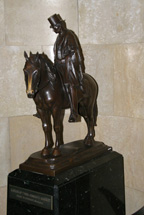 At Lincoln’s tomb in Springfield, Illinois, one encounters a series of small bronze statues placed in niches in the walls along the way to the burial chamber. My favorite is an equestrian statue entitled “Lincoln the Circuit Rider.†During the eighteen forties and early fifties, Lincoln traveled the eighth judicial circuit of the State of Illinois as an attorney, trying cases and making political friendships that would last, some of them, until the end of his life. Sherwood’s Lincoln is background to Lincoln the circuit lawyer and politician, a backwoods postmaster who owed money to everybody he knew and is forced to ask the political operatives who woo him to run for the state legislature to buy him a suit of clothes.
So that when I read Lerone Bennet’s Before the Mayflower in the late sixties I was not entirely unprepared for its portrait of Lincoln as a white racist. Bennett has since enlarged his campaign against the Lincoln myth, with Forced Into Glory: Abraham Lincoln’s White Dream, rearguing the case with a zeal like that of Amiri Baraka’s “Somebody Blew Up America.†This view of Lincoln has never been persuasive for me, though it remains a useful corrective to old-fashioned Lincoln hagiography. The view of many present-day social historians that African Americans “freed†themselves in the nineteenth century, has more robustness, however. That view informs Kate Masur’s op-ed review in The New York Times of Steven Spielberg’s new film, Lincoln.
Masur argues with considerable interpretive skill that Spielberg’s film seems dertermined “to see emancipation as a gift from white people to black people, not as a social transformation in which African-Americans themselves played a role.” I think the criticism is fair, as far as it goes. But I also think the history of emancipation is not the subject of Spielberg’s film. Masur seems to think that the history of emancipation ought to have been Spielberg’s subject, and this apparent conviction leads her to conclude that the film is “an opportunity squandered.”
But I think this misses the point. So far, the most balanced review of Lincoln I have read is that of another Masur (Louis P.) in The Chronicle of Higher Education, which sets Spielberg’s portrait of Lincoln in the context of other film portraits. You can read that review here. It is entitled “Lincoln at the Movies.” Like Louis Masur, I think of Spielberg’s Lincoln as an appropriation of the Lincoln myth, not as critique or as an opportunity for critique “squandered,” as Kate Masur observed. I see the Spielberg character as an older instantiation of Sherwood’s frontiersman, personally flawed but still possessed of a naive hope for a better world than the one he inhabits, and an iron determination to sieze the moment and achieve at least some small realization of a part of that hope.
It’s sometimes claimed that the Lincoln myth is a twentieth-century phenomenon, but the claim is wrong. Millions mourned Lincoln as his funeral train made the slow passage from the nation’s capital to Springfield:
Through day and night, with the great cloud darkening the land,
With the pomp of the inloop’d flags, with the cities draped in black,
With the show of the States themselves, as of crape-veil’d women, standing,
With processions long and winding, and the flambeaus of the night,
With the countless torches lit—with the silent sea of faces, and the unbared heads,
With the waiting depot, the arriving coffin, and the sombre faces,
With dirges through the night, with the thousand voices rising strong and solemn; . . .
Walt Whitman’s great elegy for Lincoln, “When Lilacs Last in the Dooryard Bloomed” from which I have quoted, was written in 1865, as were a handful of other poems lamenting the President’s death. And Whitman was not alone. William Cullen Bryant, Oliver Wendell Holmes, Herman Melville, Richard Henry Stoddard, and many others also wrote poetic tributes at the time of Lincoln’s death.
And it’s well known that the Lincoln myth has a good deal to do with Lincoln’s campaign biography and his own habit of referring to himself as a man who had overcome humble beginnings. This part of the Lincoln myth has been the subject of considerable critique by historians who have followed Richard Hofstadter. At one terminus of this critique one finds Lerone Bennett and a surprising crony, Tom DiLorenzo, whose book, The Real Lincoln: A New Look at Abraham Lincoln, His Agenda, and an Unnecessary War seems a polemic in support of the cynical oligarchy that now owns Lincoln’s political party.
Any living myth is an exercise in memory as reconstruction. We reinvent what Van Wyck Brooks called the usable past continually from the perspective of present needs and understandings. Spielberg’s Lincoln is as much about our present political crisis and the constant question, “What is to be done,” as it is about the political conflict over the thirteenth amendment. And as Louis Masur sees it, Spielberg’s “Lincoln fits with our own cynicism about the political process. But it redeems the enterprise by suggesting that hardfought battles can be won, that bipartisan agreement can be reached, even over the most intractable issues.”
But I think Spielberg’s Lincoln is about something else as well, maybe even more important. Abraham Lincoln has been an inspirational figure for utopians like me in the face of the political struggles of my lifetime, both in my country, and in what many of my colleagues still refer to as “the academy,” where I have spent most of my working life. Among other things Lincoln has stood for the transformative power of language, for the proposition that something like The Kingdom of God stands unrealized but realizable in human affairs, in the turmoil and bloody struggle of history—and that our dreams of human flourishing are not forlorn as long as we have poets and orators to speak them.
Kate Masur notes the absence of Frederick Douglass from Spielberg’s Lincoln, noting as well that Douglass was among the White House guests at Lincoln’s second inaugural. It may push the evidence too far to claim that Lincoln and Douglass were friends; though they met several times, and Douglass has recalled that Lincoln was surprisingly cordial to him. But Douglass delivered a memorable oration in praise of Lincoln in 1876 at the “Unveiling of The Freedmen’s Monument in Memory of Abraham Lincoln.”
Douglass’s praise of Lincoln is complex and not without an accounting of Lincoln’s prejudices. Lincoln, according to Douglass, was primarily the white man’s President. Douglass listed, indeed catalogued among others, Lincoln’s actions that from the perspective of the twenty-first century could seem those of a racist dictator. But the conclusion Douglass drew regarding Lincoln’s life and legacy is perhaps best summarized in this passage:
The honest and comprehensive statesman, clearly discerning the needs of his country, and earnestly endeavoring to do his whole duty, though covered and blistered with reproaches, may safely leave his course to the silent judgment of time. Few great public men have ever been the victims of fiercer denunciation than Abraham Lincoln was during his administration. He was often wounded in the house of his friends. Reproaches came thick and fast upon him from within and from without, and from opposite quarters. He was assailed by Abolitionists; he was assailed by slave-holders; he was assailed by the men who were for peace at any price; he was assailed by those who were for a more vigorous prosecution of the war; he was assailed for not making the war an abolition war; and he was bitterly assailed for making the war an abolition war.
But now behold the change: the judgment of the present hour is, that taking him for all in all, measuring the tremendous magnitude of the work before him, considering the necessary means to ends, and surveying the end from the beginning, infinite wisdom has seldom sent any man into the world better fitted for his mission than Abraham Lincoln.
Somewhere towards the middle of Spielberg’s film, Lincoln’s cabinet challenge him in regard to his assumption of war powers. These are well known, especially Lincoln’s suspension of habeas corpus. Some of his cabinet even claim that Lincoln has destroyed democracy. His reply is something to the effect that if the Union can be saved perhaps democracy will survive as well, as a condition to be achieved. Abraham Lincoln had considerable skill with words, though he had no great voice. But he spoke with a prophetic prescience in an age that valued both poetry and oratory. He has left us with a body of words that still teach us about social hope. We do well to treasure those iconic words.
Of course, as one critic has spelled out, there’s no historical warrant for the opening scene of Lincoln featuring two pairs of soldiers, black and white, reciting the Gettysburg address with Lincoln as audience. It’s a tableau, designed as a mythopoeic moment out of time, as is the flashback that concludes the film with Lincoln speaking the most famous passage from his second inaugural address. The point is that these words lead us on—that is why they bookend the film—that the Lincoln of myth leads us on because the Lincoln of history, like the historic Thomas Jefferson, left us a legacy of words and deeds that on the whole were perhaps better than he was. His career can be viewed as an attempt, not without a steep learning curve, to live up to the best poetic vision of his country he could fashion.