interim report

The great, glaring ways in which my society’s norms have been morally wrong have pretty much always been obvious to me; though my understanding of the subleties and nuances of these wrongs has grown and changed over the years. It has been my privilege to work to change some of those norms and to see them replaced by others that I and many of my fellow citizens hope to be more humane. But there are other, less obvious norms that are the ground of my experience as well. Last week I participated as a spectator in a forum for candidates for mayor of my city. I attended a play at the Repertory Theatre of St. Louis, known affectionately as the Rep. I attended a St. Louis Symphony concert and a church service. I spent a day judging debates at a St. Louis Urban Debate League tournament.

In these activities I participated in the civic life of my locality. I affirmed my city by living and acting in it through corporate and conventional modes of behavior. I also ate meals at restaurants and with friends, shopped for goods at local stores, drove my automobile on local streets, visited with friends in their homes and enjoyed my own. By these and countless other actions, mailing letters, using electrical appliances, keeping up with the news, watching the Super Bowl, I pursued my social and civic life as I have for almost eight decades in various places in the United States of America. From my early youth until now I have known myself as a social creature, thinking that it was both my right and my duty to participate in my society’s formal civic life but also taking for granted a host of activities and pursuits that form the accidental and complex infrastructure that gives me a physical as well as a social connection to the turning earth, the seasons, the businesses of business and of learning, modes of intentionality that are as much a part of civic life as voting.

I know myself to be a historical actor too, as we all are, living within the stream of our times. It’s tempting sometimes to think that historical milieux can change suddenly and drastically, especially in revolutionary times—but that’s usually an illusion. What looks like sudden change upon inspection turns out to be the product of a gradual evolution. Such a consequence (e.g. the turn towards fascism in the world’s contemporary democracies) appears to have happened suddenly, or relatively suddenly, only because attention was focused elsewhere, engaged with images of an order of things that had long been imperiled. I mean to speak practically, not to propound a theory of history which I am not qualified to do. I also mean to speak from my own lived experience and from no one else’s. Events that might disconfirm my argument abound, the crashing of airplanes into New York’s world trade towers being perhaps the most recent large-scale Viking raid I have witnessed personally (albeit virtually). But the tensions in the middle east in the aftermath of the founding of Israel in 1948 were nothing new in 2001, and our country’s unfortunate involvement in fomenting and increasing those tensions off and on over the years was also old news. We Americans simply thought we were invincible, that our geopolitical situation preserved us from attack.

The political changes in my country have caused me to wonder if my thinking needs to change. I have understood myself as a liberal as long as I have been an adult. But I spent my professional life working in universities except for a period in the 1970s when I worked in the community arts movement, community arts having been an establishment effort not fundamentally different from the founding of land grant universities and community colleges. I am now realizing the extent to which these experiences gave me a situation and an identity in the center of American life, not on the fringes. What I am just fully realizing is that even though I participated in protests and voter drives during the 1960s and have had an albeit sometimes rocky love affair with today’s academic left, I thought of these things as expressions of civic virtue and not as revolutionary acts. Speaking for myself, it is a mistake to identify with claims of opposition to the center. We are capitalists in the United States, as Nancy Pelosi has recently pointed out. But being capitalist is not synonymous with being American. Capitalism is and ought to be subordinate to our evolved social vision. The New Deal got part of that relationship right, but only part. For many Americans, whole social groups indeed, were left out of the New Deal and denied the goods of American life by virtue of ethnicity, gender, or social class. Our public efforts, some of them misguided, to remedy the defects of the New Deal produced systemic stresses that eventually led to the top-heavy, overly bureaucratic infrastructure that the rightist insurgency has now seized and means to exploit for its own nefarious ends. But it is the evolved democratic social vision of the twentieth century that to my understanding remains the central project of American life and that of the evolved social democracies of the rest of the world, though many of them are presently being impacted by rightist insurgencies as well.

It is also a mistake to believe that the rightist insurgency in the U. S. is a demand for small government. It may have been that in the early days (though it is hard to think of HUAC and the McCarthyist witch hunts as small government projects), but by 1964 movement conservatism was clearly an ethnic nationalist coalition opposed to emerging social change and resentful of the declining world power of the United States as the Cold War continued. Nor is today’s rightist insurgency the sole projector of neoliberal economics. One of the rifts that could destabilize our emerging rightist government could pit neoliberals, both Democratic and Republican, in the congress against the economic nationalism of the executive régime. But I think it more likely that rightist forces will unify around rolling back regulations that protect citizens from corporations coupled with various repressive social policies: scapegoating immigrants and minorities, feminists, LGBTs, public schools and universities, unions, science and scientists, professionals of all sorts—a longer list could be made. Much of this will be done in the name of religion. While it is tempting to me to identify myself entirely in opposition to the rightist insurgency, I am beginning to understand that I care most as a citizen about preserving the evolved democracy I am coming to see as the main project of my lifetime and the lives of my family and parents and grandparents.

The rightist emergence in the developed democracies of the west seems sudden (if it does) because of its determination to undo history and because of its violence. We democrats (note the small d) are accused of violence when we protest, just as we are accused of having changed the world illegitimately, albeit we represent the slow evolution of western society towards democratic institutions (e.g. universal suffrage, equal access to education, health care, and other public goods for all persons regardless of race, religion, gender, social class, place of origin, etc.) And what may have begun in this country, seems to have begun if I consult my memory and my family’s, as what was billed in my youth as an effort to ‘restore free enterprise’ has now become a movement to destroy every vestige of democratic socialism among us by any means necessary—and the harm, the pain, the social dislocation and disruption this will cause are not accidental but intended as the means of reestablishing governance by what the rightist insurgency believes to be our legitimate ruling class: white, affluent persons who subscribe not only to a radical neoliberal economic ideology but also to a reactionary and paranoid set of social beliefs that for some are reinforced by a retrograde piety that calls itself Christian. Our current Vice President is representative here more nearly than his boss, but the President adds a beefed-up nationalism and overt kleptocracy to the already toxic mix of recommended rightist practice.

One can fault Edmund Burke for many things. He could not have been a feminist. His record with respect to slavery and colonial abuse, the two great issues of his time upon which he spent the most of his energies, is mixed and problematic. He was not a democrat in any sense of the term. His most famous writing is a tract attacking the French revolution; yet he more or less supported the American. To say these things, however, is to say only that he was a man of his time. Perhaps it is more important that he was a practicing politician, spending his career in the British House of Commons, that his writings have more of the character of obiter dicta than of philosophy. The last thing I want is to endorse the uses to which Burke’s ideas have been put by American movement conservatives. Indeed what seems useful to me at the moment is more nearly what Burke has come to represent in the history of ideas than what Burke actually said about politics or history. Burke’s understanding of the French revolution was deeply flawed, his reaction to it naïve and sentimental. But his position as a politician observing and reacting to what he took to be the destruction of the evolved society just across the channel accords very well with my position with respect to my country’s present history. I have claimed now several times that we are an evolved democracy in the United States. Like Edmund Burke, our founders did not approve of democracy; but we have evolved towards democratic institutions, particularly in the last century, just as we have made some efforts to remedy the consequences of slavery, the native American genocide, and our terrible record as a colonial power. Some have said, and used Burke as their justification, that this evolution has made us weak; I believe, on the contrary, it has made us strong. Now, our evolved democracy faces, if not extinction, at least a severe and cruel curtailment. I don’t need to rehearse the horrors of the past few weeks, only to allude to them and to the fact that they are being praised enthusiastically by representatives of the rightist electorate even whilst their leaders’ behavior horrifies most Americans and indeed most of the rest of the world.

I think protests have to continue, and I will participate as I am able. Beyond protest, I think we all have to organize better than we have ever done before in order to start winning again at the polls, to fight attempts to suppress our votes in the courts and where we fail, to mount massive voter drives to obtain credentials for the disfranchised. We need to participate in local politics. We need to support our local cultural and eleemosynary institutions as well as regional and national advocacy organizations that are doing the work of democratic resistance. We in the American democratic majority have presently lost the ability to command. Some of Burke’s thoughts about France might give us pause as to why that happened; but now, we stand to lose much more. For me, at least, the realization of what I have to lose, may have lost already, is what I have to defend. It is what I think Burke saw, beyond the specifics and with all his flaws and limitations, in the idea of a developed society. Our local institutions will hold for the time being, but we have lost the ethical center of our civilization. This makes conservatives of all of us who are lifelong liberals, and it means partly that liberalism and conservatism were never a binary opposition.

But it is the specifics that count the most. It isn’t enough just to be opposed to the rightist régime because it is duplicitous, authoritarian, bigoted, and violent. That’s one of the mistakes we made in last year’s election. We have to know what things we value in our civic life, and we now more than ever need to tell their stories—the stories of all those things we had come to take for granted as permanent in our lives and in the world. Why is it that I think the rightist insurgency threatens these things? My symphony orchestra is at least half female and includes a goodly proportion of players whose ethnicity is non-white. My church officially supports the ambitions of LGBT persons. Most of the candidates for the office of mayor in my city are African American. The St. Louis Urban Debate League serves St. Louis City Public Schools, most of whose students are African American. A recent play at the Rep involved a conflict between a gay man and the mother of his dead lover. My front window now features a poster welcoming refugees. The International Center just around the corner from my house is a haven for immigrants, as is my church, which also counts a number of same sex couples among its members. I am a supporter of Planned Parenthood, NARAL, the ACLU, the Sierra Club, the Southern Poverty Law Center, and public media as well as my local art museum, botanical garden and zoo. I am a member of the League of Women Voters. From my perspective these facts are signs of the times and of my participation in the normal social life of my locality. From the perspective of the rightist insurgency, however, I am living in the middle of a politically correct community that needs to be brought into conformity with traditional values.
A Face In the Crowd

As I think about the chaos that has surrounded us in the United States since the inauguration of Donald Trump as our president, I keep finding myself in a condition T. S. Eliot describes in “East Coker,” having only learned to get the better of words for things I no longer wish to say. I have nothing more to say at this point about Donald Trump and his cabal or the Republican Party, or about my country.

Trump is being treated by his supporters and his detractors as a shiny new bauble on the tree of our public life, the new cynosure of our popular culture when we ought to be saying something like ‘surely not that again!’ For he is the worst of clichés. I don’t care whether he is smart or stupid or whether Steve Bannon is running him or not or whether the congress is using him or whether or when he will be impeached, though I don’t think impeachment is likely any time soon.

Nor do I care whether the chaos around him is accidental or part of a design to destabilize the country. Trump’s entire program is destabilizing as is the potential program of the Republican government in waiting. At this point events are in charge. I fear that neither he nor his supporters nor any of the rest of us will be able to undo the harm Trump is prepared to do—it appears he is ambitious to destabilize the world.

But we have seen his sort before again and again, the cowboy con artist with a shiv in his boot: Oliver North, Newt Gingrich, Rudy Giuliani, George W. Bush, Rick Perry. Last year there was a fashion for comparing Trump to Lonesome Rhodes, the celebrity anti-hero of Elia Kazan’s 1957 film, A Face In The Crowd, made from a story by Budd Schulberg. Turner Classic Movies aired the film on Trump’s inauguration day. Rhodes is a bad ‘un with a smarmy smile that only an actor like Andy Griffith could have embodied, but he gets his comeuppance.

Towards the end of A Face In The Crowd a survivor among Rhodes’s entourage comments ruefully to a friend, about Rhodes and others like him:

You were taken in, just as we were all taken in. But we get wise to ’em. That’s our strength. We get wise to ’em.

We can hope Trump’s charisma will fail him—it’s the arc of the action he is playing out—nobody can strut and fret forever. But he has powerful allies in the alternative fact industry whose job it is to manufacture conspiracy theories and cram them in the black hole of the rightist media.

Most Americans are already wise to Trump, have been all along. But the joke’s on us. All the while we thought we were liberals, progressives, agents of change. Now it’s a rightist minority who are driving change, people who want to pull up the last hundred years or so of international history and burn it to ashes—they are not conservatives, no matter how they describe themselves. I am a conservative. I am now, at least in some sense, a Burkean. And I don’t have words for that condition yet.

God did it . . .

In a recent op ed in The Washington Post Hungarian scholar, Miklos Haraszti, has suggested that our United States Constitution, because it is hard to change, might provide a check against the rise of an authoritarian regime in this country. But Haraszti isn’t seriously hopeful. He rather means, I think, to warn Americans about what is at stake in the rise of the cult of Trump.

The world is looking at the United States now in a way that we never thought would be possible: fretting that the “deals” of its new president will make the world’s first democracy more similar to that of the others. I wish we onlookers could help the Americans in making the most out of their hard-to-change Constitution. We still are thankful for what they gave to the world, and we will be a bit envious if they can stop the fast-spreading plague of national populism.

But what if Trump is able simply to shrug off constitutional restraint as he seems to be doing now with the emoluments clause? Who will hold him accountable? His election and the associated takeover of much of the machinery of governance in this country by a newly authoritarian Republican party (and I speak here of state legislatures and governorships as well as the national congress, much of our system of courts, and perhaps the Supreme Court) threatens not only our multicultural democracy as I have argued elsewhere, but also threatens systematically to undermine our federal system. We should have seen this when Republicans repeatedly shut our government down. We should have seen it when they refused to fund necessary infrastructure spending, as our highways, bridges, waterways, and systems of land-management deteriorated, perhaps beyond repair. We should have seen it when Republicans refused to support our armed services and veterans, indeed privatized much of our military, all the while proclaiming their patriotism. We should have seen it when they refused to confirm President Obama’s nominees to key federal posts and when they refused even to consider the president’s nomination of Merrick Garland to the Supreme Court.

But if we didn’t see the threat to federalism in these things, we should certainly have seen it in the Republican destruction of New Orleans and much of the State of Louisiana following Hurricane Katrina. Naomi Klein provides an instructive window into that destruction in the opening section of The Shock Doctrine: The Rise of Disaster Capitalism, as she describes the talk at a Red Cross shelter in Baton Rouge in the immediate aftermath of the storm.

The news racing around the shelter that day was that Richard Baker, a prominent Republican congressman from this city, had told a group of lobbyists, “We finally cleaned up public housing in New Orleans. We couldn’t do it, but God did.” Joseph Canizaro, one of New Orleans’ wealthiest developers, had just expressed a similar sentiment: “I think we have a clean sheet to start again. And with that clean sheet we have some very big opportunities.” All that week the Louisiana State Legislature in Baton Rouge had been crawling with corporate lobbyists helping to lock in those big opportunities: lower taxes, fewer regulations, cheaper workers and a “smaller, safer city” which in practice meant plans to level the public housing projects and replace them with condos. Hearing all the talk of “fresh starts” and “clean sheets,” you could almost forget the toxic stew of rubble, chemical outflows and human remains just a few miles down the highway.

Destruction of Louisiana was continued by Governor Bobby Jindal, who was ultimately defeated, but much of it remains. At the center of it was the economic gospel of Milton Friedman, whose devastation of both nature and culture Klein documents around the world. According to Friedman disaster provides economic opportunity, as in New Orleans whose school privatization Friedman praised at the end of his career. And sometimes, if God doesn’t clear the slate for Friedman-style entrepreneurship, it may be permissible or even necessary for humans to undertake the task. Autocracy will be a condition of necessary economic reform, since people will hardly vote to destroy their livelihoods in a democratic socialist state. Friedman’s complicity in the excesses of the Pinochet regime in Chile are among many things that have tarnished his reputation as a humanitarian.

We might have seen a threat to federalism in the Kansas Legislature’s attempt to destroy a state supreme court that thwarted its design to defund the state’s public schools. Ultimately the people of Kansas restrained Governor Brownback and the Legislature, whose attempt to subvert the law was made clear by public interest groups. But Kansas remains a state in which Republican rule seeks the destruction of the public sector and establishment of autocracy. So, with North Carolina, whose recently elected Democratic governor’s powers have been usurped by a Republican General Assembly, meeting in special session called before the former Republican governor left office. North Carolina’s voter suppression law was struck down in federal court and the decision was upheld by the Supreme Court. The State’s extreme gerrymandering was also struck down in federal court, but a recent Supreme Court order has suspended the special elections ordered by the lower court’s decision, pending appeal.

We might have seen a threat to federalism in the multiplication of voter suppression laws around the country designed to perpetuate Republican rule and support authoritarian regimes throughout the Midwest, and in the Supreme Court’s casuistic gutting of voting rights and campaign finance legislation. As I write this Republicans are designing total repeal of the Affordable Care Act which President Elect Trump, in defiance of fact, the medical profession, the majority of American voters, and even the insurance industry, claims to have been a disaster for too long. What is trending here is a state of affairs in which the governed are deprived of the constitutional means to withdraw consent from their governors. Some millions of citizens may be deprived of health insurance as well if the ACA is repealed, and that’s only the beginning if Republicans act on the intentions of some to destroy Social Security, Medicare, and Medicaid. In some cases the Republicans’ determination to commit destruction and throttle dissent proceeds with desperate glee and an unabashed mean-spiritedness that borders on joy. An Iowa legislator terms an attempt to deprive college students of benefits he thinks are excessive the “suck it up buttercup” bill. A Missouri legislator gleefully introduces legislation to deprive university faculties of tenure claiming the practice is un-American, no matter its venerability. A former student tweets, “Liberal tears bring me so much joy.”

What seems to be driving the trend is a combination of toxic belief in certain fundamentalisms: the prosperity gospel, the economics of Hayek and Friedman, white supremacy, economic nationalism (which in some ways conflicts with Hayek and Friedman), the social pathologies we saw on display at the Trump rallies, hatred of liberalism and its institutions including schools and universities, nostalgia for a small-town or rural past with its ethnic inequities and tensions erased, etc., but the political dissolution of the modern liberal state is an international phenomenon that is only partly understood. I think Tony Judt made a good beginning in Ill Fares The Land, but he didn’t live to complete the work. Be that as it may, we Americans have legitimately elected a strongman. We may also have given him the means to perpetuate himself in office if he desires to do so. He isn’t Hitler, who was never elected, but he already exhibits many of the inclinations of other authoritarians who have become well-nigh unimpeachable dictators. I’ve mentioned Pinochet. The Italian, Berlusconi, comes to mind as well. Berlusconi was finally unsuccessful as a politician, and he wasn’t the mass murderer Pinochet was. But he did a good deal of damage, and he is often mentioned as a parallel to Trump, particularly with respect to his corruption, his fights with media, and his flamboyant style. The constitution cannot protect us if Trump decides to shrug it off and the congress does not intervene. Given Both Trump and the present congress’s thuggish predilections, it seems far more likely to me that Trump will shrug off the constitution than that congress will act to restrain him.

I conclude at the end of these thoughts that regardless of the strength our constitution has exhibited over the past 227 years we may be facing a crisis that puts our system at peril as it has never before been imperiled. In the final analysis that system rests as much upon good will as it does upon law and tradition. By good will I don’t mean what political fashion sometimes terms Kumbaya-ism. I mean rather the ability to determine the right thing on the basis of established norms and practices—and then to do it. I mean the ability to discern and preserve the good of the whole community. These are things we stand to lose, may already have lost, in the age of Trump.

Epiphany 2017

Over the holiday I became indebted to Mary Oliver, not for a poem, but for reminding me, in a new book of essays entitled Upstream, of something Emerson wrote in his journal with regard to the Fugitive Slave Act of 1850. “This filthy enactment” Emerson exclaimed, “was made in the nineteenth century by people who could read and write.” I had thought as the holiday approached that I might find some source of real commonality with my Christian friends who voted for Donald Trump during the season in which Christians of all persuasions strive to honor the birth of the Prince of Peace, but I continued to bump up against something else that gave me pause and a need to clarify my thoughts. This essay is my attempt to do that.

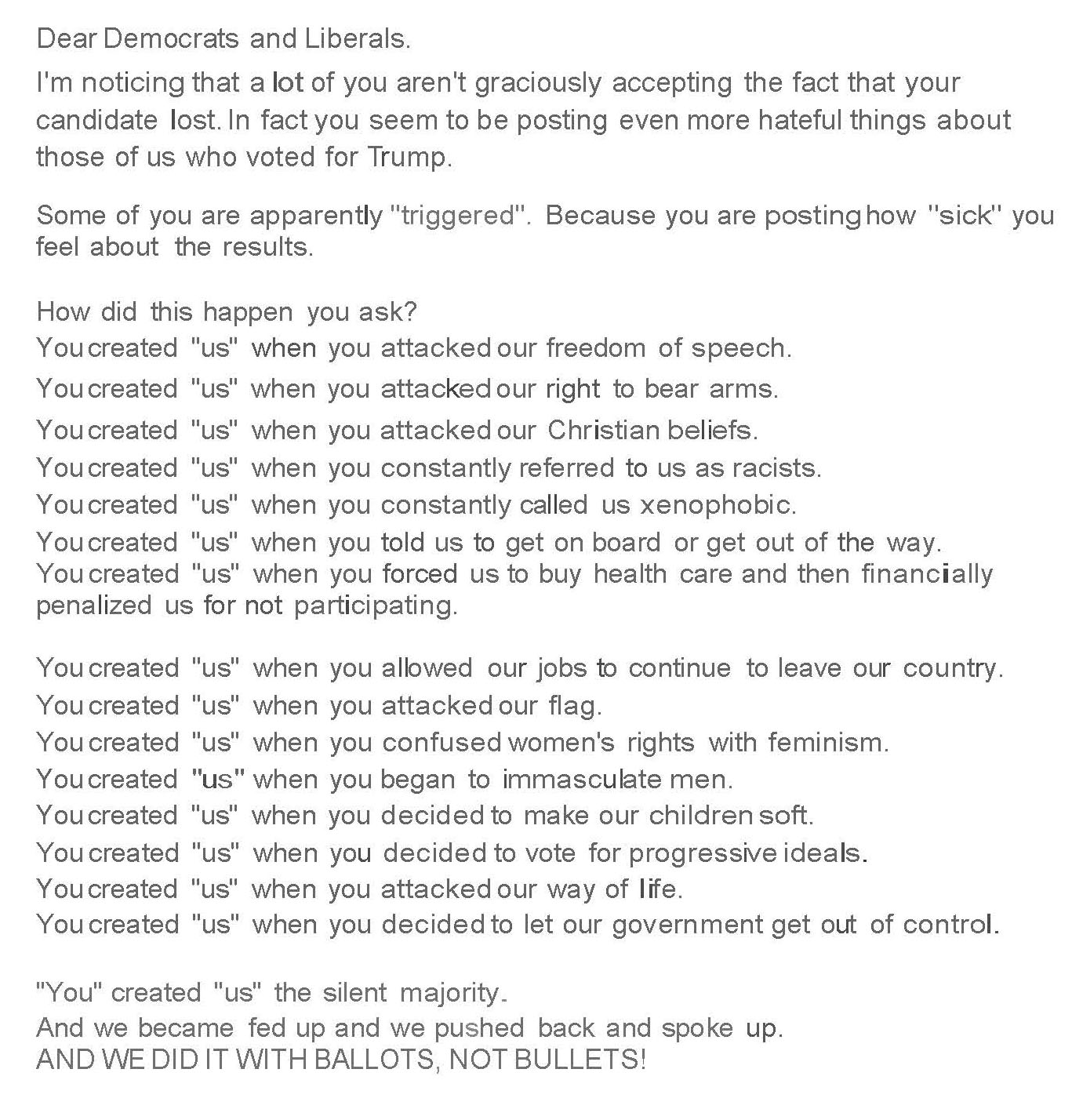
It isn’t my purpose here to add anything new to the litany of complaint that is being voiced about Donald Trump across the political spectrum by moderates and progressives both Democrat and Republican. I am dismayed by the extent to which my fellow progressives are attempting to deal with the new political reality by manipulating the same worn-out categories that failed us during last year’s election. As I write this the planning for our local Saint Louis protest march is being interrupted by arguments about whether older white women understand intersectional feminism. But I am worse than dismayed to discover the extent to which friends of mine despise those they identify as liberals, a group in which I am also included. Today I am treated to a list of the liberal crimes and aggressions alleged against me by one of my friends, who posted the following bill of particulars online at Facebook.

I am guilty as charged in many of these matters. While I don’t think the Trump victory is altogether explained by racism, misogyny, xenophobia, and homophobia I do think Trump’s campaign invited violent expression of these highly virulent and, from my perspective, utterly unacceptable social pathologies. If you read around about the website from which the list of my crimes is taken, you will see that it purports to be a news site that tells the truth for conservatives, unlike mainstream media. To me that truth appears very similar to the paranoid politics I witnessed among my friends in the 1950s when we argued about Joseph McCarthy, but the chief difference is that we live now in the aftermath of the civil rights movement. The amazing thing to me about my friends’ professed conservatism is less that it resembles former fascist excesses and more that it expresses itself in opposition to the legacy of Dr. King and others who fought and died, some of them, attempting to extend the blessings of liberty to themselves and their posterity.

My friends who voted for Trump will not like this. As the list of my crimes points out, I have attacked them as racists. So let me be clear: I regard the election of Donald Trump and the associated Republican takeover of the national government as an event in the history of my country that is more or less parallel to the demolishing of the reconstruction south by the Ku Klux Klan and restoration politicians like my confederate ancestors in Harrrison County, Texas; and my reaction is very like Emerson’s reaction to the enactment of the Fugitive Slave Act of 1850. If a man such as Trump can be elected President of the United States of America in the twenty-first century by people who can read and write, I am marooned in a country I thought was mine as well as theirs—doubly marooned, perhaps, since I seem to be despised by some progressives as well, who don’t know me but are eager to stigmatize people like me because we are white and have insufficiently, in their view, checked our privilege.

But I’m not feeling privileged at present. I am fearful—no, I am afraid. Fearful is too genteel a word for what I am feeling now. I am angry too, and I need my anger as an antidote to paralysis and inaction. Trumpism requires an answer that I need anger in order to return. There is no answering the bill of charges that I have cited here except to point out that it is the usual congeries of lies, exaggerations, and caricatures that are the staple of present-day rightist agitprop. Steve Bannon has described Trump as a great orator—talk about putting lipstick on a pig! Another Trump surrogate has famously claimed that ‘there’s no such thing as facts any more.’ As a nation we are expected to treat the prospect of building a wall along the Mexican border, the compilation of a Muslim registry, the immediate repeal of the Affordable Care Act without a thought about the social and economic chaos that will result, and a return to the nuclear arms race—all this with equanimity, and to regard politicians who propose these terrible things as normal people and the language they use in proposing and defending them as normal political discourse. We are asked to regard the prospect of our country’s becoming a Russian client along with the host of European countries Russia is attempting to destabilize as a fine thing. What’s the big deal, after all? Haven’t we been in the business of interfering in the internal affairs of other countries for better than a century, ourselves?

We are experiencing the ruin of language, a kind of ruin that is older than George Orwell’s prophetic novel, 1984. The only question I have about it is how much permanent harm it may do, for it has already done much. Thucydides thought the ancient Greeks faced such a ruin during the Peloponnesian War.

Words had to change their ordinary meaning and to take that which was now given them. Reckless audacity came to be considered the courage of a loyal ally; prudent hesitation, specious cowardice; moderation was held to be a cloak for unmanliness; ability to see all sides of a question, inaptness to act on any. Frantic violence became the attribute of manliness; cautious plotting, a justifiable means of self-defence. The advocate of extreme measures was always trustworthy; his opponent a man to be suspected. To succeed in a plot was to have a shrewd head, to divine a plot a still shrewder; but to try to provide against having to do either was to break up your party and to be afraid of your adversaries. In fine, to forestall an intending criminal, or to suggest the idea of a crime where it was wanting, was equally commended until even blood became a weaker tie than party, from the superior readiness of those united by the latter to dare everything without reserve; for such associations had not in view the blessings derivable from established institutions but were formed by ambition for their overthrow . . . . (History of the Peloponnesian War: III 82)

As I read Thucydides’ words I am hearing shouts of ‘Benghazi!’ and ‘Lock her up!’ in the back of my mind. I am hearing Trump’s imfamous birther claims about President Obama, and I am hearing still darker claims like this one, which has been spread by Trump and by a member of his transition team who eventually had to be fired as a liability.

When I think about all the children Hillary Clinton has personally murdered and chopped up and raped, I have zero fear standing up against her. Yeah, you heard me right. Hillary Clinton has personally murdered children. I just can’t hold back the truth anymore. (remarks attributed to talk show host, Alex Jones)

The problem with such language is that it doesn’t matter who gets fired or whether a YouTube video is taken down. The damage is done by the initial posting, which ignites a Tweetstorm that then continues of itself and provides the assurance of truth to Trump’s true believing multitudes, who interpret and reinterpret what was initially outrageous so as to assign it to some credible or almost credible context, in this case the abortion argument or that over policy in Syria.

But the ruin of language is not the sole responsibility of the political right. We on the left have contributed as well. Witness Cornell West’s extreme and inflammatory critique of President Obama that has helped to letgitimate the rightist critique and abetted its escape from the racism of its beginnings. Witness the extreme left wing critique of Hillary Clinton, which hardly avoided hatred, indeed sometimes seemed to court it, contributed to the heightening of Clinton’s negatives as a candidate, and may have helped to elect Trump. None of the language in which these critiques were couched was nuanced or fair. Indeed, the best that can be said for it is that most of the time, except for some of West’s more colorful claims, it avoided the extremes of rightist rhetoric. Some will blame social media for the debacle. I disagree. Social media, like other rhetorical forms, are themselves neutral and serve the intelligences that guide them. Orwell wrote in “Politics And The English Language” that our language “becomes ugly and inaccurate because our thoughts are foolish, but the slovenliness of our language makes it easier for us to have foolish thoughts.” He, Orwell, thought the process could be reversed. I’m not so sure.

So what to do? I’m thrown back to where I was weeks ago when I asked this same question, except that I now have no hope for conversation with my right wing friends. Whether we will remain friends, I don’t know. I should like to believe them when they claim that they did not vote for Trump out of racist hatred, misogyny, xenophobia, or homophobia; but when I encounter their detestation of people they call liberals I cannot sustain that belief, and I understand that I can have nothing further to do with their politics or their piety. Moreover, I am frankly sick of hearing and reading about the righteous and longsuffering white working class. My friends are affluent. Their class loyalties and their religiosity are pure identity politics. I now have ample proof that they despise me in the abstract, however much they may profess to love me personally, and I am no longer able to see much difference between being despised in the abstract and being personally detested.

The rest of this essay is addressed to the unfortunate reality that reactionary Republican control of my country is the new norm. This will do great harm and cause great pain before it runs its course. I will likely not live to see the end of it. Those of us who care about preserving and enlarging the multicultural democracy we have built as Americans over the past fifty or sixty years must be content with soft power and expect that all the force of the right-wing state may be arrayed against us. This is not new, but it does mean that we must return to a posture of organizing and protest with which we have lost familiarity in recent years. I have already joined up, but I have to say that we need to stick together. We cannot afford to pursue our present task in the disjointed and fragmented way we approached the last election. We need to realize that our historical position makes us conservatives in the present-day world. Before we can make further progressive gains we have to commit to an existential struggle to retain the gains of the recent past.

I am not new to struggle. A couple of posts ago I talked about my experience at Fort Bragg. Perhaps here I can be forgiven a brief reference to my participation in an event in the spring of 1968 at Duke University that we called the Vigil. I was a graduate tutor at Duke that term, and I held class on the quad. I corraled my students as I could and coaxed and cajoled them to finish their semester’s classwork whilst we all demonstrated in solidarity with a local union, mostly African American, that was seeking recognition by university administration. It was not Duke’s finest hour. Some Trustees’ opposition to union recognition was openly and viciously racist, and when the university capitulated we all believed an important victory had been achieved. But I was just as proud of the list of grades in my gradebook that term, not a single incomplete. We had changed the politics of a southern city, and we went on to accomplish further changes. We had participated in a national movement, blessed by such lights as Bob Dylan, Joan Baez, Pete Seeger, and Adam Clayton Powell. But I had persuaded my students to protest in the midst of their productive lives rather than abandon them as I was forced to do at North Carolina State two years later when a similar protest at the state capital in the aftermath of the Kent State murders occasioned administrative orders to faculty that we were to give incompletes to all students who disappeared from our classes.

I am not new to protest. I am not new to efforts to bring democracy to my country. I have been checking my privilege longer than my young progressive friends have been alive. But it’s all good. I do not resent their suspicion of me, and I occasionally argue with one or two of them I love. I am almost eighty years old now. I have seen this past Christmas season come and go with no glimmer of hope or comfort I can take as assured on the horizon of my immediate experience of the world. So be it. I will fight this new reality with every resource available to me. As I say, I have already joined up. I was not arrested at last November’s union rally, though I may have to plan to be arrested in the uncertain future. I hope all of my friends and colleagues on the left will forgive the observation that we no longer have time for arguments about intersectionality. We need solidarity. If we continue to bicker and fragment our forces into factions each claiming a special ideological purity, we will lose the necessary struggle before it has a chance to begin. We need to face the fact that we have lost control of our country’s republican governance even though we remain a democratic majority nationwide. Our task now has to be to find ways to convert the soft power we have as a democratic majority into structural power again. For that we are going to need new leadership, new thinking, new categories. It’s hard for me at my age to contemplate the necessity for a new mindset and for continued activism when I’d really like to escape into my books and my memories, but the times are as they are.