Electronic publications:
“Bryan’s Ragtime Stride” Friends of Scott Joplin, January 13, 2020.
“Nineteenth” The PIker Press, June 14, 2021.
“Farm Road Entropy” The Piker Press July 19, 2021
“Deep Ecology” Better Than Starbucks, August 2021*
“Mnemonic” Eunoia Review, August 4, 2021.
“Great River Road” Eunoia Review, August 5, 2021.
“West” Eunoia Review, August 5, 2021.
“Zapper” The Piker Press, August 16, 2021.
“Poem in August” The New Verse News, August 30, 2021.
“Colloquy With Dean Rader and Emily . . . .” Litbreak Magazine, September 18, 2021
“Events of !939” Litbreak Magazine, September 18, 2021
“Nomad Country” Litbreak Magazine, September 18, 2021
“Lament for the Makers” Litbreak Magazine, September 18, 2021
“After Implosion” The Piker Press, September 20, 2021
“End of the World” The Piker Press, October 18, 2021
“Pandemics, So Called” The New Verse News, November 8, 2021.
“Anthropocene” The Piker Press, November 15, 2021
“Duncan and Brady” The New Verse News, November 19, 2021; reprinted in CulturMag, December 1, 2021.
“Springtime 2019” The Piker Press, December 13, 2021
“Long Homestead in Winter,” The Piker Press, January 17, 2022. Reprints in O’Henry and Pinestraw.
“Three Eco Reflection Poems” Lothlorien Poetry Journal, January 30, 2022.
“The Alpine,” The Piker Press, February 14, 2022
“Bayboro Harbor 1999” Raw Art Review,SUMMER/FALL, 2021, pp. 129-130
“Silverback” The Piker Press, March 21, 2022
“Chain of Rocks”The Piker Press, April 18, 2022
“Pure Onionhood”The Piker Press, June 27, 2022
“27 Club”The Piker Press July 25, 2022
“Field of Dreams, 2022” New Verse News, August 14, 2022
“Greek to Us” The Piker Press, August 29, 2022
“Wind in the Willow” The Piker Press, September 26, 2922
“Moonshadow” The Piker Press, October 24, 2022.
“Searching for Amédé” The Piker Press, November 21, 2022.
“Penguin Provender” The Piker Press, December 19, 2022.
“Recuerdo” New Verse News, December 23, 2022.
Johann’s Boy The Piker Press, January 9, 2022.
“Winter Cyclone Haiku,” “Johann’s Boy” Verse Virtual, February 2023.
“Oil Patch, 1980” The Piker Press, February 27, 2023.
“Against Melancholy” The Piker Press, March 27, 2023.
“Animal Counsel” The Piker Press, April 24, 2023.
“May Day” The Piker Press, May 8, 2023.
“Earthrise” The Piker Press, June 19, 2023.
“Almost Ghazal for Them Cowbirds” The Piker Press, July 17, 2023.
“Microaggressions” The Piker Press, August 21, 2023.
“In the Name of Heaven” The Piker Press, September 25, 2023.
“Towards an Unaesthetic” The Piker Press, October 23, 2023.
“More than Macaronic” The Piker Press, November 20, 2023.
“Epiphany at the St. Louis Art Museum” The Piker Press, December 18, 2023.
*featured poem
Watch this space for forthcoming electronic publications.
Selected Print Publications
“I have heard of this book already,” said Don Quixote, “and verily and on my conscience I thought it had been by this time burned to ashes as useless . . . .”
*High Wire Man . . .
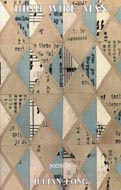
High Wire Man · To a Woman, Singing · Under Construction · In Durham, Living on the Margin · Wittgenstein’s Lion · Fuþark · Homunculus · Philosopher · Murder Sonata · Vocalise · No Thanks · Bach’s Retraction · Symposium · Take the Hard Road Home · Heart of Flight
*Trilobite Press has been sold to Triangle Nonprofit Publishing, whose website is a work in progress. If you’d like a copy of High Wire Man, write here, or write the author at longjulian@gmail.com.
“These . . . ,” said the priest, “do not deserve to be burned like the others . . . , being intellectual books that can hurt no one.”
Reading Evening Prayer in an Empty Church . . .
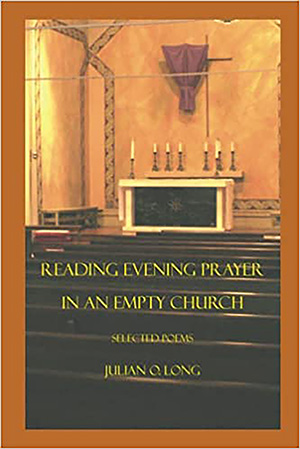 This collection includes 80 poems. Here are some selections. American Pie · Autumn Catalogue · Train to Dallas · Reading Evening Prayer in an Empty Church · Flatbush Waltz · The Echoing Green · Obiter Dictum · Pressmen · Salvationists Escaping · From a Further Room · Christmas Eve · Streams of Mercy · In sure and Certain Hope · Weymouth Woods · Monumental History
American Pie
Janis Joplin was a tough
little Texas girl, you said
who busted her butt to be a star
but if there was ever any music it disappeared.
Maybe we never heard it anyway.
If there was ever any music
I lost it at the Eagle cafe
where lunch was Theresa Brewer
and my friend Jack Benny Cunningham’s yellow boot
came down on the neck of a little Mexican
we’d called a wetback–
we could have killed him.
The week before, we’d killed a deer
trapped him in the headlights, bird-dogging
in my granddaddy’s old Dodge. Then we were
on him with pocketknives, and the more he
struggled the more we cut, until
he stopped.
But I think Janis Joplin died of hype
and when the music disappeared behind
night-slapping windshields from Newark to Saigon
we didn’t understand. All we ever wanted
was to get there.
Have you outstripped the rest?
Are you the President?
Out on the road
You’ve got nothing left to lose, born again
and amplified, faster than Richard Petty
drop-kicked through the goal posts of life.
[First published in New Texas 1998, 1999]
Autumn Catalogue
Bravely
as the light flies
I tell you how my heart breaks
for one red maple
on a hill in South Carolina
and for a redtail hawk
how autumn tramped that country
in dirt feet, keening
like an old song. I reason
that things are most themselves
in autumn when at four o’clock
the sun from high cirrus cuts
tall poplars.
Their yellow hands holding the blades
they abide the time
over farms
and country roads. My hand
translucent as I
write by this window
displays its architectonic–
tendons slide along the knuckles
gently lift the net of veins
where the life goes home, and I recall
how soft your eyes are sometimes. If
my character likewise
should be exposed
it would be found a somewhat overbloomed
perpetual. But if found at best
I think I could hollow out my bones
wait with the redtail hawk
in a known spiral upwards, all
utterance suspended. Glaciers snap
quite suddenly
my hair is white, a hawk cries
westward.
[First published in Weymouth:An Anthology of Poetry Edited by Sam Ragan, 1987]
Train to Dallas
As I have moralized it
we rode through grey
December pastures
half-steamed windows
of our coach revealed
black against them here and there
mesquite, post oak, scrub cedar. I
nodding into Lear, as Kent
into wheels turning, kept the
season in the stocks.
Dead father, please come back!
I, too, would lead you by the hand–
Look there! cried the old mad king
closing Cordelia’s eye, a door
to tombs in Leicester whence he went
that day the rails beneath me throbbed
as though they were the joists of heaven.
There is a grief of old men, saturnine
as Texas winter towards the solstice–
my grief too, borne inward as the death of God.
The oldest have borne most, been comfortless
incapable; my grief to search for fathers I had wronged
by too much love.
[First published in Pembroke Magazine 1978]
Reading Evening Prayer in an Empty Church
It’s good to be here, Lord,
even if you’re not, even if all
that’s behind the crucifix
is the eastern wall.
Chrysostom says it takes two.
I’m never sure that angel on the back bench
knows anything, sitting there with his big square
wings folded, reading the editorials.
I’ve seen his kind streak across the sky
now and again, bound for races or baseball,
thrown a few high thoughts their way,
but I don’t really want their life.
Not that here is an easy place.
My clothes are too tight. I worry. Sometimes
I get depressed. But what if I stopped
in this place just to get my messages?
This here, this room into which I speak
is quite enough height for me, and maybe
someday we’ll all of us get the message. Home,
this is home, with its not very permanent light.
Here or nowhere, me or nobody–
it’s well.
[First published in Windhover, January 2001]
Flatbush Waltz
In a book he called Thad Stem’s First Reader, the author recalls his first love, a young woman named Rose Blatz, who taught him a few words of Yiddish, and whom he characterizes fondly as the ninth candle of the Hanukkah menorah. Of the ninth candle, Leo Rosten observes that it stands taller than the rest, being the candle from which the other eight candles are lit, one for each day of the feast, and symbolizing that one can give love and light to others without losing any of one’s own radiance. Jessica is Shakespeare’s Jessica, in The Merchant of Venice, who might have had Andy Statman’s Flatbush Waltz in mind, when she said, “I am never merry when I hear sweet music . . .
[In a doggerel rhythm, like a slow waltz]
Kings and queens in their limousines,
like these in their threadbare velveteens
were pearls that we stitched da da dum
da da dum
and now our dance is plain as boards
but our feet still turn as we sway, da da dum
we are sober as sawdust, flat as shirts
but we flame as we step, we shine, da da dum.
Dum da da dum two three dum each tink
of the mandolin drums to the fiddler’s tune
curling and sad and sweet da da dum
like Hanukkah candles or wine from a spoon.
When in sweeps Jessica nee Rose Blatz
ninth of the candles, or first, da da dum,
she shines in full measure, out-darking the time,
the fiddle bow stitching up skeins of pearls
to the music she steps, da da dum da da dum.
Come along you squires, you easy riders
madonnas with chutzpah and pizzazz,
put an ear to the witness, eye to the shine,
put your foot, mark the music, it droppeth
like rain.
This sad sweet waltz is a journey somewhere–
beyond some long march, out past the last prayer,
the last mitzvah waiteth with Jessica there.
Dance is commanded, no wallflowers here,
they shall dance in Jerusalem all, next year.
[First published in Windhover, January 2001]
The Echoing Green
As many times upon the running lawn,
The spangled night of iris-fragrant spring
Was the various and populated town
Of our first knowledge of near everything.
No tigers prowled about in that first world,
No spiders in the fragrant lotus there;
Around our rose-tree house a serpent curled
Benign and fructed sleeper, centered fair.
We played creation round about its head
Magicked friendship from the tuneful skies
And being spectral, chaos shrank and fled
Finding the darkness deep as we were wise.
Now, having lost the mothering gift of play
We strain at common love the livelong day.
[First published in The Sewanee Review, Spring 1972]
Obiter dictum
It was five a. m., the papers say
when you slipped away in your sleep.
It must have been a quiet departure
unlike you, who were seldom at a loss for
words. I’m damn sorry I missed your funeral,
sorrier to have missed your conversation
all these years.
Not that you were unquiet–
you held it in and wept, if you wept,
in a place apart (not unlike the rest of us either
wearing charity like a millstone). I often found
you behind your old Underwood at the paper
banging away with two fingers at that old devil
language. I learned from you never to use the
word rue or to put a comma at the end of a line,
learned to value some common truths, like the
way you always asked, “How you feelin’?”
and probably meant it. I miss you no more
today than during ten years silence
though the thought of you grows hollow.
You were a sociable man. I found it
easy to love you
and knew you loved me because I knew you to hate me
once. I had seen a weakness you couldn’t abide–
the circumstance no longer matters, but the truth
can’t be left out. Like the memory of torn pride
whatever we carry of others in us,
stays.
[First published in New Texas 1998, January 1999]
Pressmen
It is late. I sit at a long deal table
in an upstairs cafe across from the paper
and watch the pressmen come in from their shift.
We will drink coffee for a while. Again I will think
I know why they wear those squat little hats
folded from newsprint, why they do not
take them off–then we will go.
The hats are a disguise to make themselves
pressmen, like gunnery sergeants or stevedores–
a disguise and a badge. “We are men,” they say,
“who tend a machine, feet sunk in fifty-foot rock
and long as a football field, that rips words from air
as it whirrs like a saw, eats ink, tree trunks, arms.”
Most have fingers missing, some have more.
One tips back his chair and tells a story about his son,
pushes the hat back on his balding head and scratches;
another tips the hat forward, tells of an argument
with his wife, as if to say, “You know how women are.”
Here, at the end of their shift, they still need to wear the hats–
even as they wrap the arms of their minds around each other,
because they are men with stories they do not
entirely wish to tell.
And that is because they aren’t really pressmen at all.
One is a breaker of horses, who carries a fire in his belly
that drives him to make subjects of hammers, automobiles,
his lawn mower. Another is drunk on God. In the dark
hours away from the press, God visits him. They smoke
a calumet together, tell lies and love the lies they tell
as though they were incense drifting up from sacrifice.
The central one, he to whom others defer, will one day be buried
with his weapons. When centuries lift the broadsword from his ribs,
they will find him to have stood seven feet tall. And the small
one at the fringe of the group, the dark one who smiles a lot–
no one knows he loves a woman who sang to him once in Greek.
A luthier, he sleeps in the grain of true and high harmonics
a sheet of spruce thin as a plectrum crushed to his ear.
[First published in Windhover January 2001]
Salvationists Escaping
The crisis is always the same.
What if, after collecting coats and toys
TV sets, gratuitous old shoes, we should slip
broke and walking out of Sherman’s Atlanta
barely ahead of gangrenous caissons and burning?
And suppose the children were not
the same every year with surprised grandmothers
getting canned goods and hand me downs, but refugees
with swollen bellies begging the roadside
and sooty fingers plucking our penniless sleeves.
It has somehow to start elsewhere.
The world I make love to has always
had your skin. Its roots and contours
swim in your sea, telling each other touching
all the things that are told.
Yet there is always that other, sometimes
so much of it we die for a while or a lifetime
(once as a child I caught the same
tiny fish forty-seven times). In Sherman’s fires
we swim, tiny fish in buffalo grass.
Love because you must before the world wakes
to the dead city and everything gone but smoke.
Tug at each other’s coatsleeves. Do not let go–
as though there were someone to forgive the burning
as though there were someone to love us but ourselves.
[First published in New North Carolina Poetry, The Eighties, Edited by Stephen E. Smith, 1982]
From a Further Room
—for Dona and Rob Anderson
“But is it really
music?” you complained.
We were talking of Stan Rogers, coming out
with new tunes even though he’s dead, music
(or not) mostly made at the engineer’s board.
I thought of dour old Mennonite women
on hand at the fair in Iowa City
like my Swedish grandmother, long since moved away.
New music made them stiff last year. ‘I’m here,
but I don’t like it,’ their demeanor seemed to say.
New gospel, slick as TV, gave them nothing to pat their
feet to.
Earlier, we had talked of your new house in Door County,
seen photos of friends on a friendly beach. Rob mused, “We
wrote three books together,” pointing out one of them. Then
we talked some more about land and trees and water,
I still thinking of “Paradise” and saying
fretfully how we blow whole mountains away
and think to make it good by planting grass.
If new music fails perhaps it lacks something
of the earth we know. Gordon Bok sings of weather
I can only imagine, being southern; yet his voice, recorded
fills a room, sonorous as woodsmoke. Listening, I almost think
I’ll be a Maine man too. Rogers, doubly absent, sings of Nova Scotia
—but the rhythm is a Texas two-step.
So if music pegs us to known earth, maybe new music
reminds us how we are sometimes tied to objects of desire
we don’t understand. A damsel with a dulcimer
in a vision once I saw . . . heard melodies are sweet,
but those unheard are sweeter, as once in Taos
I watched a young woman dance alone
in herself, complete—
taking, as she did, space meant for a hundred.
New music surprises us, arrives all at once in the air
from nowhere we had ever expected to go. Sometimes
we don’t like it, but this year the Mennonites rocked
to the strains of “I’ll Fly Away”—
and perhaps all music is new,
like sleep on the westbound porch
at my Swedish grandmother’s house in Las Cruces
where the Santa Fe whistled hollow and high.
Nuzzled as close to some heart of it as we can get,
we sometimes write books, cook risotto, argue—
take naps in the moonlight while somebody
not present calls the tune.
[First published as a broadside by Backroom Window Press, 2011]
High Wire Man
He starts at dawn.
From a hill above a tiny
French village a wire stretches up
over cottages parti-colored, harlequinesque
a single steeple, tall beeches swaying.
He walks at first like a tumbler, leaping
and changing his feet, turning cartwheels
about the pole that balances–one false turn
but he catches himself last instant before
dead weight–and then the long stride
over the housetops, each step centered
afresh.
Do we really hope he falls–
Isn’t it the overcoming that thrills
each step an overcoming not of death
but of something like slavery, on the wire
to fail beyond shame? We imagine fear of
broken bones and agony, death of deaths
by violence, but ask him and he’ll tell you
he is at home on the wire. Think of the pole
the balancing, the purity of it. Any life
he loses isn’t his own.
From his heart stretches another wire
tugging towards the hard planet–
what he risks is loss of height, but in
the end the heart implodes, wires run to ground
over a little stile, step foot in a field of folk.
We cheer and weep–ask and he’ll tell you
he was at home on the wire.
Under Construction
–at the MoMA in 1983
What did Rilke mean
«you must change your life»
that a dead god speaks
through a broken statue?
or that the statue, mutilated, is
the god, absences noted–
here in the MoMA the issue is
simpler, most of the galleries closed.
A rope separates me from The Starry Night
whose “careful use of line, space, and spiral
. . . creates a sense of reckless speed.” It is
nonetheless a small canvas. The cypress
in the foreground enflames less than
observes, a lonely spectator almost outside
the rope with me. Van Gogh needed a wall.
Nearby trois demoiselles, huge and histrionic
scandalize the room, its neutrality, its spotless
temporariness. The heavy brushstrokes of their thighs
are brass fists–the flat planes of their faces slap the air.
What absence teases here? Art deco furniture
Bauhaus models, an Escher drawing or two
return to book–Van Gogh returns to book.
Only the bawdy demoiselles disturb the silence.
I turn to them, smug as if
to say: Be still! We are in charge–
see, we have shouted these others down
and nothing will ever be the same.
Wittgenstein’s Lion
Wittgenstein . . . made the most interesting
mistake about animals I have ever come across.
At the end of the Philosophical Investigations he
says that if a lion could talk we wouldn’t be able
to understand him.
—Vicki Hearne
If some lion were to speak
(to say nothing of lions at large)
that one would be a failed beast
thin-maned and ugly, lacking among its kind
any familial tie to the king of
same.
A hearer of voices, that
one would scheme of poetry–
in the desert would invent
riddles that slouched like athletes
thick muscled, gigantic.
Of course, the lionist culture would fail
its pretensions exposed by a skinny Algerian.
A postcard mailed from a desert town
requesting copyright, would be returned
because it arrived without a stamp
but think of the romp they would have.
Lionish translations would burgeon–
Imagine the Nicomachean Ethics roared
the Iliad’s great periods hugely purred
the New Testament conceived
as an antelope hunt.
Soon would arise a tradition
of lionist conversation, courtesy having
its Leoniglione, politics its Leonavelli
verse a Leonighieri, a dolce stile
a sprezzatura of the leonine.
In the new lionist Aeneid
the hero remains in Carthage
to wed the African queen.
Having conquered the interior
the lovers found instead of Rome
a belletrist academy
teaching all subsequent history
to keep a civil tongue.
I made nothing–
that has to be said
at first, not the little
klavierstücke so loved by parents
(hated by children) not a cantata
toccata, passion, chaconne,
not the great fugue, none of it
I made.
Nor, and this is hard,
was I its instrument–not one breath
in the pipes that caused these hands
and feet to dance on burnished wood
was mine. I felt that breath,
thought it, I suppose, like Pascal’s
reed, knew it even for what it was
«soli deo gloria» but I never . . .
better to say, my God,
that it made me.
And the great fugue?
I laid it out, signed it, sought
to perfect it, failed; but the heart
of it, peace to men of good will–
good will the highest good of all
sublime above all other–some profess
they were taught it by a philosopher;
I forget his name, a pietist I think,
no matter. That was the great
fugue, not mine but God’s.
Had I been its instrument
I should have died sooner, incarnate
lost in its incarnation, surviving
only as long as memory lasts;
but we know that God’s music (there
is the word) sheds its skin like cicadas
I used to find as a youngster in Eisenach
choristers whose thousand juicy voices
thronged high summer nights. Nor was
the what the wonder, more nearly the whence–
brilliance of silence unfolding with jeweled speech
(don’t believe the philosophers, music is sound)
and oh my Lord my God the rush of it, sometimes
not to be borne, the organ bench my only safety,
only calm in the wind that made me crazy!
The muse first sought me out in the church
at Arnstadt; we made music weekdays
until the council discovered us.
An angelic flute she was, in the antique
style, God’s voice a violone,
wheeling like the planets–I had been
to Lübeck to hear Buxtehude play
overstayed my time, neglected my choir . . .
I’m no good for philosophy. Give me black
and white keys, wood diapason, reed diapason,
gut, tin, or brass, handy, homely things: I am homesick–
always was homesick–the great fugue
took me home.
Twelve o’clock we keep the feast.
Like promise of familiar grief
the time surrounds
as carols pour from deepest flutes
for which there are no organs and
the solemn plainsong is as light
suffused in darkness of the one
beginning.
A boy steps to the pulpit,
the antique ruff at his neck
the type of an antique tongue.
He reads by candlelight an antique tale
of a maiden in a garden and a star.
As the miracle is announced in his choirboy
Voice, piped in this house to which both it
and he belong—there
is the breath of God.
We should do well to ask
him where the story
begins. He cannot tell us
but we may discover the child
beneath the altar, find in memory
of him or her joy glimpsed down corridors
not closed, merely unopened until now
here in the darkened church
hung with rosemary.
We do not speak of the one beginning
carrying it within as though we stood
at daybreak by the sea, naming
as we did when we were small
creation’s names, thinking to relearn
languages of birds, fish, grasses
of stars and their spectacular companions
in the long and open night, now lost
with the designs of our first parents.
I dream an archaic woman
offers her man child to a star
that it inhabit him, become
his heart, burn fiercely as he burns in life.
Later, he will learn the song one sings
to the great eland in the three-day hunt
running sometimes two hundred miles
across the desert, learn the ticking
in his chest that is the eland’s reply
and finally the prayer one offers
to the spirit of one’s animal friend
(a person of the early race),
whom one has killed and eaten
as one must, begging his pardon
as one must. I cannot myself imagine
the speech of elands or a lived experience
for which to converse with beasts
is an ordinary occupation
not reserved for saints or children,
or affect to know the end
or seek beginnings in observances,
dramatic gestures, when to search
there is ever and again to find
darkness at the edge of flame
last ripple either side of birthdays
coming and going, always in time.
Limited by my skin, I must
be just here, discontinuous
with all I seek to know. We have come
into this place and said the mass.
As we break bread the light we pass
from face to face is Christ and incarnation.
Yet we do not share the feast with cedars
in the nave or squirrels who even now
in winter run upon the roof.
Seeking the focus of supernal action
as dancers move within the absolute,
the one beginning waits
in silence in a darkened sacristy
always preparing to enter like
a shadow, like the power of the child
in memory revealing, not a liturgy
unsaid, but seas and snowfields, places
we once played, crushed mulberries on sidewalks
the porcupine we startled in the wood.
To find the seedbed of events, you must
be empty of events. You have only to run
in silence with the eland.
On Christmas Eve
nothing is yet actual.
The created world
sleeps with the child
newborn, a gift in time.
We keep the feast.
As the choir invokes the Lamb of God
we are already lost, each circumstance
of giving a translation of beginning
into end. But on this Christmas Eve
just here, we walk dreaming down westward
aisles, beyond the end we know into a time
perhaps where gleemen sing, small and having
yellow eyes, and panthers breathe down cloisters
warm with cinnamon.
Just here perhaps and quite by chance,
purpled kings flash past us in the chaste and
given darkness, chaste as though we had kissed
before we knew that we must die.
[First published in A Christmas Pudding: A Yuletide Offering, 1986]
Streams of Mercy
?Weymouth Center, January 1978
Except a corn of wheat
fall into the ground and die,
it abideth alone.
Snow in the shrunken wood.
When it fairs off, as they say here
the season will turn cold.
For weeks now I have found
black husks of wasps in the old house
driven in by the chill—
heard their senile dives
at windows, thinking that winter
was something they never prepared for.
Mornings get the better of me now—
my debts forgiven might permit
that I should be alone in San Francisco
but it will not do.
I find the space I need
in the afternoon, to stir things up
before my blood burls down like sap
with the weight of other lives.
Beyond first fringes of trees
I jog around a little paddock
meet friends. We laugh
and shovel snow a while together—
then I go on. Life is heat, I think
gamy with becoming.
In the big meadow low clouds
continue my breath, Eros among
the ecologies, my body’s exhaust
connecting. Then down a long clay road
just covered with thin white dust
past pine and poplar smelling of oaksmoke
I run like an ostrich
fire under my arm.
I compose a letter to tell you
how I hear your voice
in winter silences
where aunts and uncles hide and seek
amongst old marriages.
Needing the child I was
I design a world in which
perhaps we sang Italian songs together
translated Rilke, whispered in the dark,
but my bubbling wrists (which now
especially do not touch your cheek) remind
me that winter gets into us all
turning our grave desires to gauds
that light our way as we perfect the past.
A boy crouches in early dusk
behind my eyes
knowing the center I seek
those to whom I have belonged,
belong. Certain years
ago I turned Episcopalian
studied Latin, failed at grief.
Today, my forty-year-old heart
beats at most one hundred eighty
beats per minute, give or take a few.
It slows a beat a year.
Now as our faces
recede into museums
my love tells over friends
and songs of Schubert, for whose sake
I once learned German.
I think that all our lives
are other lives, when leaving art I strive
to master transformations of my will
as I spent the summer of my nineteenth
year with Tolstoy, my thirtieth
with Middle English dialects. I have
gret wonder, be this light
how that I live—
A hand in mine fiercely grips my thumb.
Two shadow men we stand,
big and little.
Back in the meadow
walking now, I reach
for permafrost. I could stop
like Scott’s dogs on an instant—
click—like that, in mid stride,
my muscles blinked into crystals
my eyes unperceiving this long expanse
of winter, passionless
architectonic, the skin of the wasp.
I think I know his winter.
It is the distance between my hand
and yours, the given space we start from.
Summers we make ourselves, inside
our own winter skins.
[First published in Pembroke Magazine, 1981]
In Sure and Certain Hope
—I have been very jealous for the Lord.
I.
Lord,
I am unable
to expect a resurrection.
A good many absent
now call from overseas—
mostly I don’t answer.
I loved my grandfather as a slight man
of seventy, thin almost transparent
who whistled thinly through his teeth
as he sliced pecans with his pocket knife.
Once, before gum disease, heart attacks
and the flu pandemic of 1918, his teeth
had been his own. He stood six feet three
inches tall, my mother tells me, and weighed
two hundred pounds. Departed love does not
simply vanish but dies or lives according
to the mind’s experience—I almost said
according to whim. If there should be a resurrection
will I see my grandfather again and know him?
Will he be as I remember him
or the young man I never knew?
The question is naive I realize, but how
shall the dead be resurrected? St. Paul says
we shall be changed. Shall we have new bodies then—
and if so how is it that it is we
who shall be changed?
I loved my father, or rather, I loved
my father’s ghost. Dear heart, he wrote my mother
from a tent on Bataan, I set my microscope up
in the jungle today. We are trying to deal with sick call–
lots of malaria. In the citation from the war department
I read that he sacrificed himself for his weaker comrades
on the March to Manila, which he survived. In the newspaper stories
describing his life’s end (on a sinking ship torpedoed by his comrades)
I read how Japanese soldiers clubbed prisoners to death with rifle butts.
Oh hear us when we cry to thee—
I should pray for closure, but you did not ask
that I pray for such, only for daily bread.
A girl I grew up with, robust, rebellious
in the way West Texas gives beauty to some women
became my friend at college. Marriage broke her
before cancer. Not long before she died
she told me she had cut down
to ten cigarettes a day, her countenance innocent
as her morphine-drenched eyes. Suffering, having
refined the souls of many, might still be efficacious
but I am unable to expect a resurrection.
II.
Because we perish, we are immortal.
Yesterday I downloaded a photograph
of earth from space. The globe, familiar
from childhood as an object of faith
now sheathed in a thin wash of cloud, that breaks
here and there to reveal the outline of a continent,
floats in the small blackness of my computer screen—
a tolerable blackness, only a little like the silence
of eternal space that frightened Pascal. My less
than immortal soul recalls how the cello spoke
at Meyerson Symphony Hall, how fajitas tasted for
lunch. I should prefer to be resurrected than to prowl
the cycles of Karma with Oedipus, but the zest
of common life, the risk and the common loss
are as close as I can come to immortality.
I expect the predicted ice age to remain an inference
in my lifetime, expect that I shall perish before
my civilization and my family, but resurrection
generally seems not so much the final
cause of perishing as an empty falsification
—anger now is sharp and hard and timeless as a scythe.
St. Paul tells me that my corruptible must put on
incorruption, in the words of the king’s translators.
I think the order of being is otherwise: the incorrupt
corrupts, and nothing may be recalled. We know this
and deny the knowledge.
III.
A child stands at a window: looking
out or looking in, what is seen is secret.
Mynheers of Salisbury, recombinant DNA
peer through separate windows at the last secret.
Perhaps it is the secret of the Dutch countryside
straightened from the North Sea. Perhaps a bell
calls monks to prayer as forests of napalm
flower out to the strains of Mozart. Perhaps
the memory lapses into barbarism, a life taken
or death sought, pay the life price or not,
as Oedipus did—picture and memory drown among ships
cities in the Aegean lost like Noah’s flood
or the stories one can never remember at parties.
Somewhere between my father and grandfather,
what I have touched and loved and Oedipus shunned
is the common—the ayenbite of inwit not
conscience so much as a sometimes trivial
preoccupation with the details of the tragedy.
The ayenbite of inwit—
I compose two letters
to be placed in the same bottle.
You were often wrong, I tell my first
anonymous pen pal, especially when you
set it down that knowledge is easy, well begun.
You opened what you thought was the small
door to a small room, fairly well lit
and you thought you saw a domestic cat
sunning itself on a window seat. Perhaps
the tabby was there, but you missed the tiger
under the bed. On one wall you saw a clock
and on another a crucifix. You concluded
that all was well. Death was not in the
room at all, only a kind of death ex cathedra.
You were restless and you denied it, heartsick
for God and you denied that too. It was the clock
that comforted you.
An aggressive student argues passionately
that if Oedipus had acted reasonably
on the road to Thebes (i.e. refrained from killing
Laius, his father) he should thereby have avoided
the horror of his life. We agree that tragedy is the loss
of possibility, that freedom is tragedy the instant one acts
for the action closes off all possibility outside itself.
I maintain stubbornly that Oedipus acts according
to his nature, in which he is not given avoidance
that avoidance remains a possibility only in some
world that Oedipus does not inhabit.
Surely, I reason in my second letter,
you would not vouchsafe me the sharpness of thought
only to deceive my credulous nature. Surely some
grace transcends my particularity. Wisdom
(or perhaps Copernicus) teaches that the earth
roams restless in the empty firmament, but surely
some heaven obtains, not unlike the small blackness
of my computer screen, where speculum mentis
turns out a true cosmology, and the wished planet
turns home. The reply begins: Dear heart—
That which is somewhere possible could maybe be
a resurrected savior . . . .
IV.
Peace carries with it, says Whitehead,
a surpassing of personality—somewhere before
the tragedy starts, we learn the world, or rather
pose it to ourselves as a thing to be done
a set of occasions to be sought. A harmony
of harmonies attends the perishing
of that neurotic focus of attention
that was the occasion of our first being,
but desire for a second chance is the last infirmity.
Some inwit remains to the end, corrupts the child
one was, a sickness unto birth.
As I work now in this space before morning
I know that unspent grief draws interest, and that
is the real death. If I forego this unspeakable monody
who will forgive me, who will pay?
I compose a third letter, to a friend dead three days
into the new year. I tell him I loved his mind
even when it failed. For a while he had hoped
against hope for remission—he was my priest.
We said goodbye near the end, and for a brief time
I was his priest, too. I put my arms around him as I held
his sickness and my own.
[First published in Pembroke Magazine, 1997]
A sign at the park’s edge
warns me not to destroy or remove
any plant, rock, or mineral.
I wonder if water qualifies—
assuming a walk in the rain,
if I step in a puddle and carry
some water away, am I a thief?
I wonder if pine cones qualify, being
dead. I remove a few pine cones, strands of
longleaf straw, a few giant bull bay leaves,
parts of the local decay, as wormy webs catch
in my hair, wrap around my ears–all with a
watchful eye out for the ecology police. You never
know when some ardent urban survivalist will
round you up and strip search you, looking for
contraband pine cones in your bodily orifices.
Later, I walk in the big meadow.
Paths branch out like fringe from its edges,
connecting–every path joining another,
paths through, paths around, all going nowhere.
I meet persons on horseback who ask that I speak
so that their horses hear my voice.
They like that, the horses, they know then that I
am not a monster, that their masters need not
summon the ecology police. One master drives
a sulky, calls out a cordial hello
as he clucks his tongue to his trotter and murmurs,
“You’re all right, baby, you’re all right.”
Padding along I dream of secret houses
with mysterious inner rooms, entrances and exits
verging and merging but leading nowhere. The emotion
of my dream is a vague alarm, shot through
with occasional streaks of fear and a queer
joy. I think of Martin in his Black Forest hideout,
nursing bewilderment at the time that had so scarred
him and dreaming of numinous tropes. But why did even
he call language a house if not to evoke
some strife between nature and culture? The park sign
closes the woods off like a Texas cattle guard.
“Human, step no further!” it orders.
In the night a spider leaves its mark on my calf.
I am thinking of making a sign of my own: “Worms,
woods, insects, all other humanivorous beings, proceed
no further! Stay out of my bodily orifices. Make no new
ones in my skin. Announce yourselves by calling out
a clear hello.”
I step to the window to watch
the ecology police and see instead
scores of humanivores,
planting signs and fences
on pine cones, leaf mulch, ant hills—
“Harvester ants. Do not disturb!” one reads.
[First published in Pembroke Magazine, 2016]
Here in the knife shop
most folks don’t worry about the past.
August, and we are a good way out
the Jacksboro highway. The sun kills
anything that moves. Locked cars have been
known to explode.
Next door at the stonecutter’s, though
you hear a story worth a walk
through goatheads and broken glass
past the cur chained up in the daytime
who eyes you and growls down a row of blank
tombstones–he’s hit the end of the chain
too many times.
Behind the stonecutter’s shack
Robert E. Lee sits in a low chair
in the bed of a Model A pickup.
It was the present stonecutter’s
granddaddy, who carved him on order
from a town in Missouri, drove all
the way up there and had to bring him
back, because folks in Missouri wanted
Lee on a horse.
He’s still for sale.
[First published in New Texas, 1999]